Japanese Knotweed: What a Survey Will and Will Not Tell You
A RICS Home Survey Level 2 or Level 3 includes a visual inspection of accessible grounds, and the surveyor should report suspected Japanese knotweed where it is identified during the inspection. Where appropriate, the finding can be assessed using RICS management categories.
You do not usually need a separate specialist Japanese knotweed survey before commissioning your normal home survey, unless there is already a particular reason to investigate.
Two things are worth knowing before you read anything else about this. The old seven-metre rule no longer applies under the current RICS guidance. And a survey carried out in winter may reveal considerably less knotweed than one carried out in summer.
The seven-metre rule is gone
If a page still tells you that Japanese knotweed within seven metres of a property automatically falls into a particular risk category, it is using an outdated assessment framework.
RICS, the Royal Institution of Chartered Surveyors, published revised guidance on Japanese knotweed and residential property that took effect on 23 March 2022.
It replaced the earlier 2012 information paper that introduced the seven-metre rule.
The revised guidance was subsequently reissued as a RICS Professional Standard in October 2022, without material changes to its requirements.
The change followed concerns about the old approach, including a House of Commons Science and Technology Committee report that described the seven-metre rule as a blunt instrument in mortgage-lending decisions.
RICS adopted a more proportionate approach informed by research into the actual effects of Japanese knotweed on property.
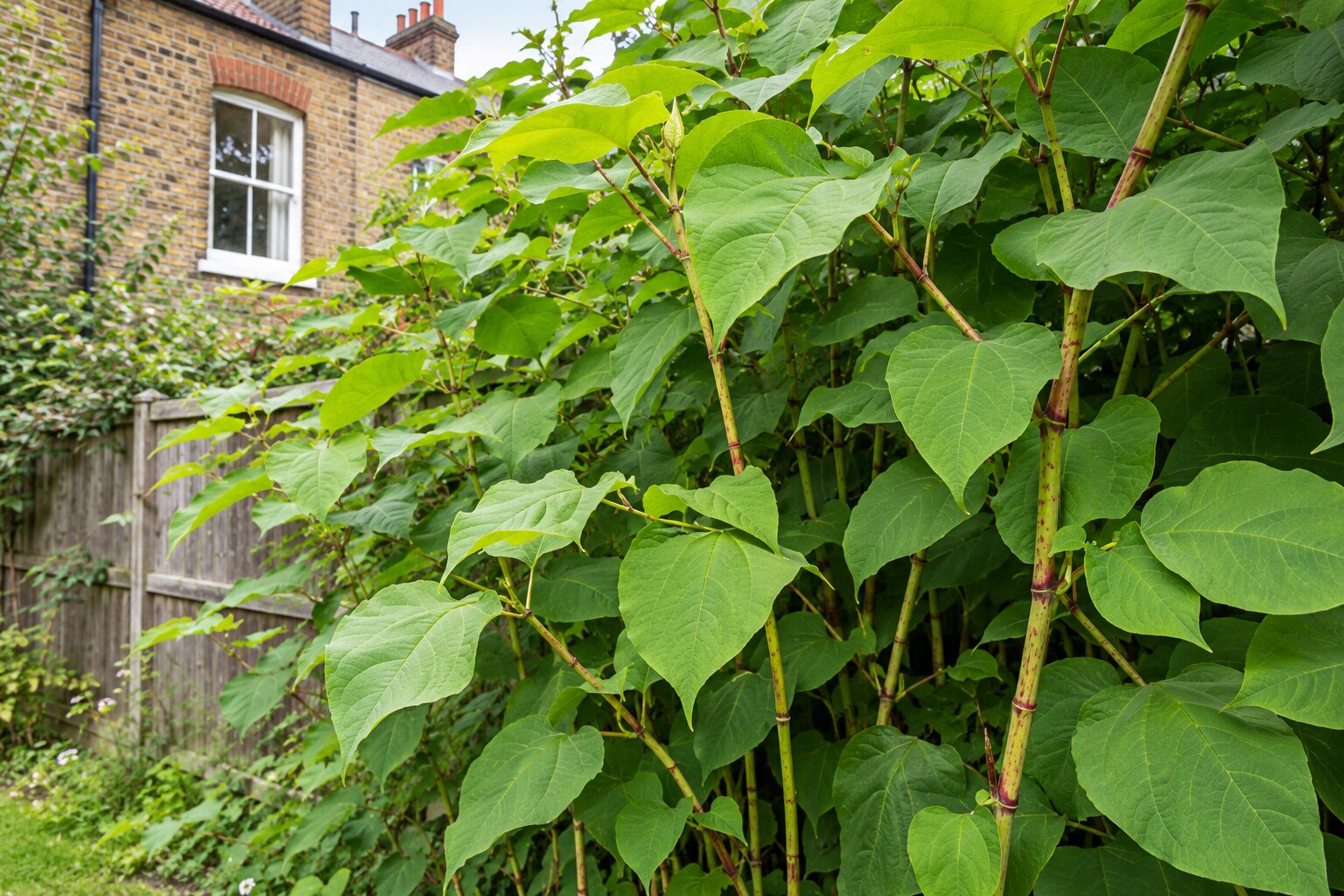
Two things replaced the old framework:
Impact instead of distance. Assessment now focuses on whether the plant is causing visible material damage to a significant structure or restricting the use of amenity space, such as a garden, patio or outbuilding area. The distance between knotweed and habitable space does not, by itself, determine the management category.
Three metres for neighbouring land. Under the RICS reporting framework, knotweed observed on adjacent land within three metres of the property's boundary falls within Management Category D.
That is not a new universal safe-distance rule. Growth beyond three metres may still be relevant to a private client's report where the circumstances warrant it.
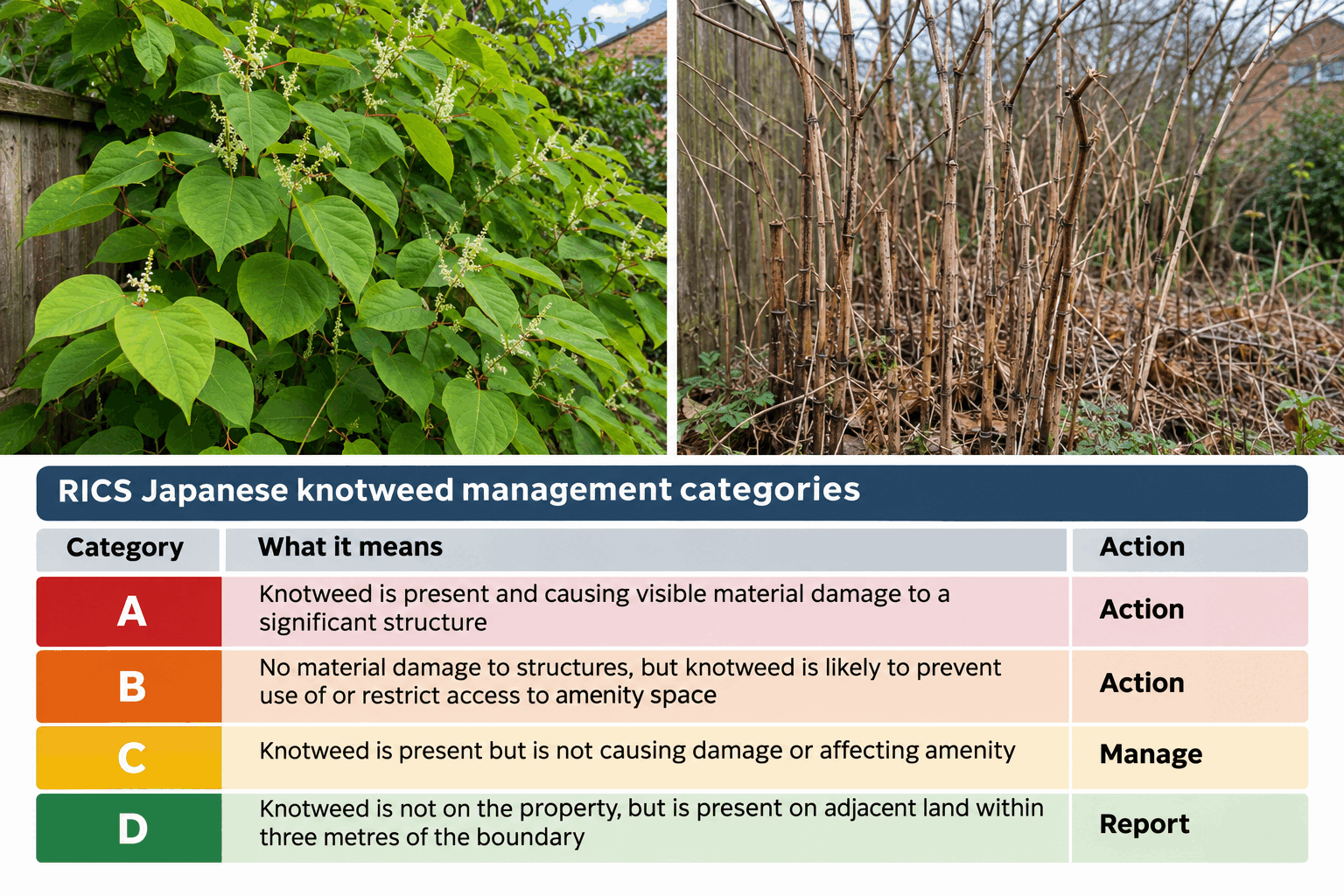
The management categories
Findings are assessed using four management categories, A to D, replacing the old numbered risk categories.
Category A represents the most serious circumstances in this framework.
| Category | What it means | Response |
|---|---|---|
| A | Knotweed is present and causing visible material damage to a significant structure | Action |
| B | No material damage to structures, but knotweed is likely to prevent use of or restrict access to amenity space | Action |
| C | Knotweed is present but is not causing damage or adversely affecting amenity space | Manage |
| D | Knotweed is not on the property, but is observed on adjacent land within three metres of the boundary | Report |
Be careful what you read elsewhere.
Some older pages still refer to risk categories 1–4, while others incorrectly describe Category C as knotweed outside the property's boundary.
Category C means knotweed is present on the property without the damage or amenity restrictions that would place it in Category A or B.
The management category helps explain the nature of the finding, but the practical implications still depend on the property, the infestation and any lender requirements.
When the survey happens matters
This is one of the most practically useful things on this page.
Japanese knotweed produces visible growth during the growing season, typically from spring through summer and into autumn.
Over winter, the above-ground growth dies back, often leaving brown, hollow-looking canes.
In a garden that has been tidied, those canes may have been cut back or removed, leaving little visible evidence.
The underground rhizome system can remain alive even when there is no obvious green growth.
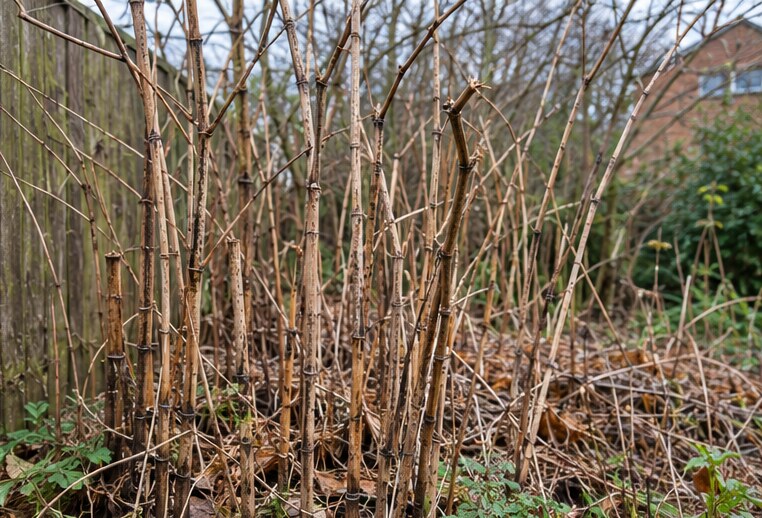
This means the season affects how likely a visual inspection is to identify knotweed.
A summer inspection may provide better opportunities to recognise the plant, while a winter inspection can be more limited.
However, even a clean summer survey does not prove that knotweed is absent.
If you are buying during winter, or the seller has disclosed a history of Japanese knotweed, tell the appointed surveyor before the inspection.
Ask whether the timing or available evidence makes specialist investigation appropriate.
Why a survey can still miss it
A home survey is a visual inspection of areas that can be seen and safely accessed within the agreed scope.
Knotweed can be missed because:
- It is dormant during winter.
- It has been cut back, strimmed or otherwise concealed.
- It is growing behind a shed, under decking or in an inaccessible garden area.
- It is on neighbouring land that the surveyor cannot access and has limited visibility of.
- It is growing on a railway embankment, vacant site or similar land beyond the boundary.
- Its growth is immature or difficult to distinguish from other plants without specialist identification.
Cutting or strimming Japanese knotweed can also increase the risk of spreading viable plant fragments if not managed appropriately.
A standard home survey does not involve excavating the garden or conducting a comprehensive botanical investigation.
None of that is a reason to skip the survey.
It is a reason to understand what a clean result does and does not prove.
Do you need a specialist knotweed survey?
Usually not as the automatic first step for every buyer.
A sensible starting point is to commission an appropriate home survey and tell the surveyor about any known or suspected Japanese knotweed.
The sequence that makes sense for many buyers is:
-
Commission your normal survey.
A RICS Home Survey Level 2 or Level 3 can identify and report visible Japanese knotweed in the areas covered by the inspection.
If the plant is identified, the surveyor can explain the apparent circumstances and use the RICS management-category framework where appropriate.
-
Arrange specialist investigation if knotweed is suspected or identified.
A suitable knotweed specialist can assess the infestation, consider its extent and advise on treatment or management.
The investigation may include mapping the visible growth and reviewing available evidence about the site's history.
-
Check what your lender requires.
Where knotweed is affecting the property, particularly in Category A or B circumstances, your lender may request specialist information, a management plan or evidence of suitable remedial arrangements.
The precise requirements depend on the lender.
Going directly to a specialist survey may be sensible if you already know Japanese knotweed is present, if the seller has disclosed it or if you believe you saw it at the viewing.
It may also be appropriate where significant building works are planned and suspected knotweed could affect excavation or soil disposal.
What it means for your mortgage
Lenders take Japanese knotweed into account, but they do not all treat it in the same way.
The management category helps communicate the nature of an infestation.
Depending on the circumstances and lender policy, the lender may:
- Request a specialist report.
- Require a treatment or management plan.
- Ask for evidence of an appropriate guarantee.
- Impose a mortgage retention.
- Require further investigation before making a decision.
- Decline the property as security in some circumstances.
None of these outcomes is automatic for every category.
A Category C or D finding may have different implications from an infestation causing material structural damage or restricting amenity space.
Because lender policies vary, tell your mortgage broker or lender as soon as Japanese knotweed appears in a report.
Do not wait until after negotiating with the seller to establish whether your lender will proceed.
The legal position is narrower than people assume
Buyers often arrive at this subject believing that Japanese knotweed itself is illegal.
That is not the position.
Simply having Japanese knotweed on your property is not, by itself, a criminal offence, and there is no universal requirement to remove every infestation.
However, the law addresses its spread, handling and disposal.
GOV.UK guidance for England states that landowners must prevent Japanese knotweed on their land from spreading beyond their property.
Allowing knotweed to cause nuisance or spread to neighbouring land can also lead to legal consequences depending on the circumstances.
Under the Wildlife and Countryside Act 1981, it is an offence to plant Japanese knotweed or otherwise cause it to grow in the wild.
That is one reason why cutting, strimming, moving soil or handling knotweed without appropriate precautions can create serious problems.
Japanese knotweed plant material and contaminated soil removed from a site may also be subject to controlled-waste requirements.
Off-site disposal must comply with applicable waste legislation and the relevant authorised disposal arrangements.
There are specific rules for certain forms of on-site treatment and disposal.
Do not assume contaminated material can simply be placed in ordinary garden waste or moved to another property.
Anything beyond this, including what the seller disclosed in the property information form and whether that disclosure creates legal rights or obligations, should be discussed with your conveyancer.
If it turns up in your report
Work through it in order.
-
Read the category and the surveyor's wording.
Do not react only to the word "knotweed". Consider what has actually been identified, its location and any reported impact.
-
Speak to the appointed surveyor.
Ask what was visible, whether identification is certain, what the management category means and whether further investigation is recommended.
-
Get specialist advice where appropriate.
A competent Japanese knotweed specialist can assess the plant and provide recommendations, including a management plan and likely costs.
-
Tell your mortgage broker or lender.
Confirm what supporting documentation is required before making further financial commitments.
-
Decide whether it affects the price or your decision to proceed.
Base any negotiation on the specialist's findings, likely management costs, relevant damage, restrictions on use and the implications for the property.
Treatment may require a programme over several years rather than a single visit.
The length and type of treatment depend on the infestation and the agreed management approach.
Where a guarantee is offered, check:
- Who provides it.
- What it covers.
- How long it lasts.
- Whether it is insurance-backed.
- Whether it transfers to a new owner.
- Whether your lender will accept it.
- What monitoring or continuing maintenance is required.
Do not assume that every guarantee is transferable or acceptable to every lender.
Does it affect what the property is worth?
It can.
The impact on value depends on the nature of the infestation, the property, any physical damage, its effect on amenity, lender requirements and wider market perceptions.
The effect is not necessarily limited to the cost of treatment.
A property with a documented management plan, completed or ongoing treatment and appropriate supporting guarantees may be viewed differently from one with an untreated infestation and no paperwork.
However, there is no universal percentage discount that accurately reflects Japanese knotweed.
Any price discussion should be based on evidence rather than a general deduction simply because the word "knotweed" appears in a report.
A specialist assessment, written quotation and suitable management plan are a better starting point for that conversation.
Should you buy a house with Japanese knotweed?
Buying a property with Japanese knotweed is not automatically unreasonable.
For example, a Category C finding involving a stand away from the main building, with no damage or amenity restrictions, may be a manageable situation.
A suitable management plan and clear documentation can help you understand the implications.
Cases that warrant more caution include:
- Visible material damage to a significant structure.
- An infestation restricting access to or use of important parts of the garden.
- An untreated infestation with uncertain extent.
- Missing or inadequate management documentation.
- A seller unwilling to engage with reasonable enquiries.
- Planned excavation or major building work affected by knotweed.
- A lender unwilling to proceed on terms you can meet.
The decision should be based on the evidence, the property's circumstances and advice from the relevant professionals.
Frequently asked questions
Does a house survey check for Japanese knotweed?
A RICS Home Survey Level 2 or Level 3 includes visual inspection of accessible grounds within its scope. The surveyor should report Japanese knotweed where it is identified and can use the RICS management categories as appropriate. A normal home survey does not guarantee detection of every infestation.
Does the seven-metre rule still apply?
No. The former RICS seven-metre assessment framework was replaced by guidance effective from 23 March 2022. The current management categories focus on the infestation's impact, with a three-metre boundary provision for reporting knotweed observed on neighbouring land. That is not a universal safe distance.
Do I need a specialist knotweed survey?
Not automatically before your main home survey. Specialist investigation is worth considering if knotweed is identified or suspected, has been disclosed by the seller, or may affect planned building works.
Can a survey miss Japanese knotweed?
Yes. It is a visual inspection. Knotweed can die back over winter, be cut back or grow in places the surveyor cannot see or safely reach. A negative finding does not guarantee that knotweed is absent.
Will knotweed stop me getting a mortgage?
Not necessarily. Lender policies vary. Some lenders may proceed subject to specialist information, a management plan or an acceptable guarantee. Others may impose conditions or decline. Check directly with your broker or lender.
Is Japanese knotweed illegal?
It is not automatically an offence simply to have Japanese knotweed on your land. However, legal responsibilities can arise from its spread, causing it to grow in the wild, nuisance and the handling or disposal of contaminated material. Rules and circumstances matter.
How long does treatment take?
Treatment often takes several years, especially where herbicide programmes and monitoring are involved. GOV.UK guidance explains that herbicide treatment commonly takes at least three years. Timescales depend on the infestation and the treatment method.
Get a survey quote
If you are buying over the winter, have noticed suspicious plant growth or know that Japanese knotweed has previously been reported at the property, tell us when you enquire.
We can pass relevant concerns to the independent surveyor as part of your enquiry, subject to the applicable privacy and consent arrangements.
Jurisdiction note
This guide focuses primarily on buying residential property in England and Wales. Rules and processes may differ elsewhere in the UK, so buyers should take advice appropriate to their transaction and jurisdiction. The GOV.UK invasive-plant guidance referenced here is specifically directed at England, and local requirements should be checked where relevant.
Important disclaimer
Important: This guide is provided for general information only and is not legal, financial, mortgage, valuation, ecological, invasive-plant management or professional surveying advice. Property transactions, individual sites and lender requirements differ. You should seek advice from your own conveyancer, lender or mortgage adviser, the independent surveyor appointed for your property and an appropriately competent Japanese knotweed specialist before making decisions or entering into a legal commitment. A home survey is subject to the scope, limitations and terms of engagement agreed with the appointed surveyor and cannot guarantee that all infestations, concealed plant growth or other defects will be identified.
Further reading and sources
- RICS — Japanese knotweed and residential property
Official professional standard:
- RICS — New Japanese knotweed standard comes into effect
Explanation of the revised categories and the replacement of the seven-metre rule:
- RICS — House surveys: The costs, types and benefits of one
- RICS — Home survey standard
- GOV.UK — How to stop Japanese knotweed from spreading
- GOV.UK — How to stop invasive non-native plants from spreading
- GOV.UK — How to sell a home