How to Renegotiate the House Price After a Survey
You can renegotiate at any point before exchange of contracts. The government's guide to buying a home confirms that where a survey identifies significant issues you can ask the seller to carry out the work, renegotiate the price to reflect its cost, or withdraw.
What makes an ask succeed is not how much you want. It is how well you can evidence what the work costs.
Ignore the percentage rules
Search this question and you will be told to ask for five to ten per cent off, or one to three per cent for non-structural issues. Treat those figures with suspicion. None of the pages publishing them cites a source for post-survey reductions specifically, and at least one supports its numbers with research about buying below asking price, which is a different thing entirely.
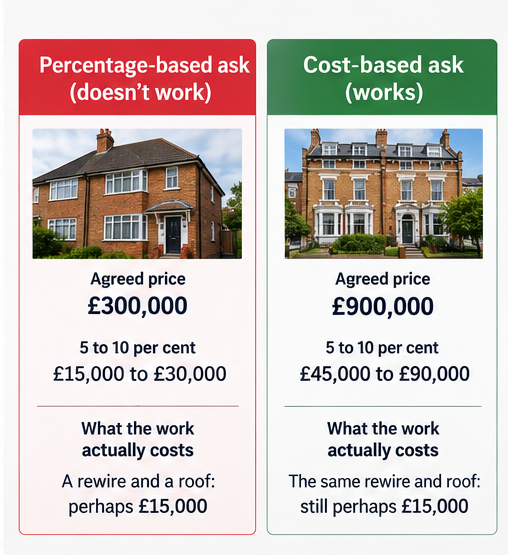
The deeper problem is that the logic does not work. Repair costs do not scale with property value. A full rewire costs roughly the same in Hull as in Hackney. Applying a percentage produces nonsense at both ends:
| Agreed price | "5 to 10 per cent" | What the work actually costs |
|---|---|---|
| £300,000 | £15,000 to £30,000 | A rewire and a roof: perhaps £15,000 |
| £900,000 | £45,000 to £90,000 | The same rewire and roof: still perhaps £15,000 |
On a London purchase the percentage approach will either make you look unserious or, on a cheaper flat, leave money on the table.
The unit that works is the cost of the work. Price the defects, evidence the figures, ask for that.
First, separate what you can evidence
Before deciding anything, you need to know how serious the findings are. Our guide on how to work out how serious the findings are covers the triage. Then sort the findings into three groups, because they carry very different negotiating weight.
Strong: diagnosed, urgent, costed
A condition rating 3 where the surveyor has described the defect and a contractor has quoted for it. This is where almost all successful renegotiation comes from.
Weak: maintenance items
Rating 2 findings that need doing eventually. These were arguably priced into the market value already, and asking for all of them reads as a general discount rather than a response to the survey.
Not yet usable: uncertain findings
A rating 3 saying investigate further is not a number. Nobody knows what it costs yet, including you. Either get the investigation done or leave it out of the ask and say you are waiting on it.
If you are unsure which is which, our guide to what the condition ratings mean sets out the system.
Get the quotes
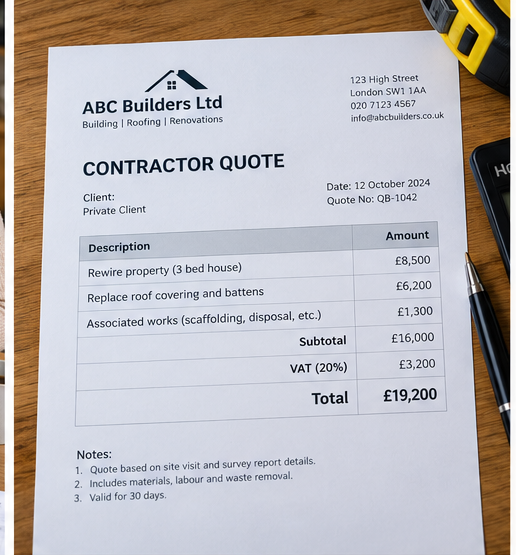
The report will not contain prices. Pricing repairs sits outside the surveyor's remit, which is why surveys do not price repairs. A surveyor working to the standards of RICS, the Royal Institution of Chartered Surveyors, will talk you through the findings, but they will not cost the work or negotiate for you.
So get written quotes, and make them count:
- Two quotes per significant item, three if the figures diverge
- Itemised, on headed paper, from firms you could actually appoint
- Scoped against the survey wording, so the quote and the finding visibly match
- Dated recently
If your Level 2 report keeps saying it cannot reach a conclusion, the problem may be the level rather than the property. A Level 3 Building Survey analyses causes and sets out repair options, which gives contractors something firmer to price against.
Decide the ask
A defensible method:
Urgent and structural items
Ask for the full cost. These are works you must do, and soon.
Significant but not urgent
Ask for part of it. Somewhere between half and three quarters is a reasonable position, on the basis that you get the benefit of newly done work.
Routine maintenance
Leave it out. Including it weakens everything else.
Add nothing for inconvenience. It invites the seller to treat the whole number as padded.
Then sense-check the total. If it is a large share of the price, the honest question is not how to negotiate it but whether this is the right purchase.
Make the approach properly
Go through the estate agent, and copy your conveyancer. The agent is legally obliged to pass on your position, and they often have more influence over the seller than you do.
Put it in writing. A short message carrying a clear structure:
- What the survey found, referenced by section and rating
- What it costs, referenced by quote and amount
- What you are asking for, as a single figure
- That you want to proceed and can move quickly
Share the relevant extract. The government's guide notes you may wish to share the relevant part of your survey with the seller's legal team to support any of these outcomes. Share the pages that evidence your ask, not the whole report.
Be specific and be calm. Vague or inflated requests are easy to refuse. An itemised, evidenced figure is hard to argue with because it is not really about opinion.

If the seller says no
They may. Sellers refuse for reasons that have nothing to do with the merits: they have a purchase of their own depending on the figure, they have had other interest, or they simply do not believe the quotes.
Your options then:
- Ask for the work instead of the money. Agreed in writing through the legal teams, with scope specified. You get less control over who does it and to what standard.
- Meet in the middle. Common, and often where this lands.
- Ask about a retention or completion credit. A sum held back from the completion balance can achieve a similar outcome without formally changing the agreed price. This must be disclosed to your lender, and it is a matter for your conveyancer to set up. It is not a way around anything, and an undisclosed arrangement affecting the price is a serious problem rather than a clever tactic.
- Proceed at the agreed price and budget for the work.
- Withdraw. Before exchange you can, losing what you have spent so far.
On that last point, your survey fee is spent either way. Our guide to what a survey costs puts that in proportion against the cost of proceeding on the wrong terms.
Watch the mortgage and the clock
Your lender
If the agreed price changes, your mortgage offer may need reissuing, which takes time. Tell your broker or lender early rather than after you have agreed a new figure. If the lender has separately down-valued the property, that is a different conversation running in parallel and the two interact.
The timing
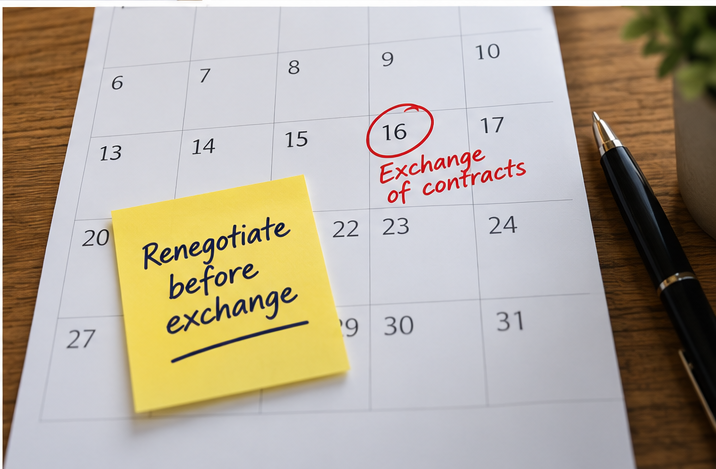
The government's buying guide makes a point worth taking seriously: you can renegotiate at any point up to exchange, but attempting it as a sale nears completion may cause delays and risk the sale falling through. A survey identifying significant issues is a justified reason to reopen the price. Doing it late, or over small items, is where transactions break.
Tell your conveyancer and the agent what you are doing as soon as you decide, rather than letting a date slip without explanation.
What the seller is weighing
Worth understanding, because it tells you how to pitch.
The seller is comparing your revised offer against the cost and risk of starting again: a new buyer, several weeks, another survey that will probably find the same things, and their own purchase possibly collapsing in the meantime.
That calculation usually favours agreeing something with you. It stops favouring you if your ask looks opportunistic, because then they reasonably expect the next buyer to be more straightforward.
Which is the practical argument for an evidenced, proportionate request: it is also the one most likely to be accepted.
Frequently asked questions
Can you negotiate the house price after a survey?
Yes, at any point before exchange of contracts in England, Wales and Northern Ireland. Neither side is legally committed until exchange.
How much can you negotiate off after a survey?
There is no set figure, and percentage rules of thumb are unreliable because repair costs do not scale with property value. Base the ask on evidenced repair costs: the full amount for urgent work, a share for significant but non-urgent items.
What is a reasonable reduction?
One that matches documented costs for defects the survey identified. Reasonable, evidenced requests succeed far more often than large unexplained ones.
Should I ask for money off or for the seller to fix it?
A price reduction usually gives you more control, since you choose the contractor and the standard. Asking the seller to carry out works can suit urgent, clearly defined jobs.
What if the seller refuses?
Ask for the works instead, try to meet in the middle, discuss a retention with your conveyancer, proceed as agreed, or withdraw. All are legitimate.
Will renegotiating delay my purchase?
It can. Allow time for quotes and for the seller to consider. If the price changes, your lender may need to reissue the offer.
Can the seller pull out if I renegotiate?
Yes. Before exchange either side can withdraw, which is why a proportionate, evidenced ask matters.
Get a survey quote
This guide is general information, not legal or financial advice. Your conveyancer, broker and surveyor should advise on your own transaction.