Butterfly Roofs and Parapet Gutters: What to Check Before You Buy
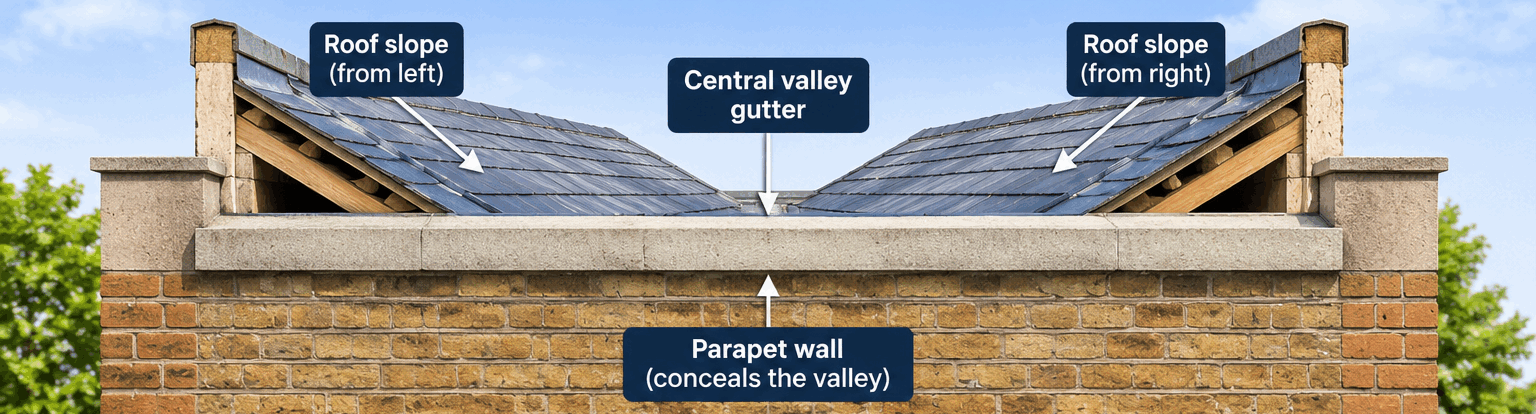
A butterfly roof has two slopes pitching inward to a central valley gutter, hidden behind a parapet wall at the front. They are common on Georgian and Victorian London terraces, and the valley is the part that fails.
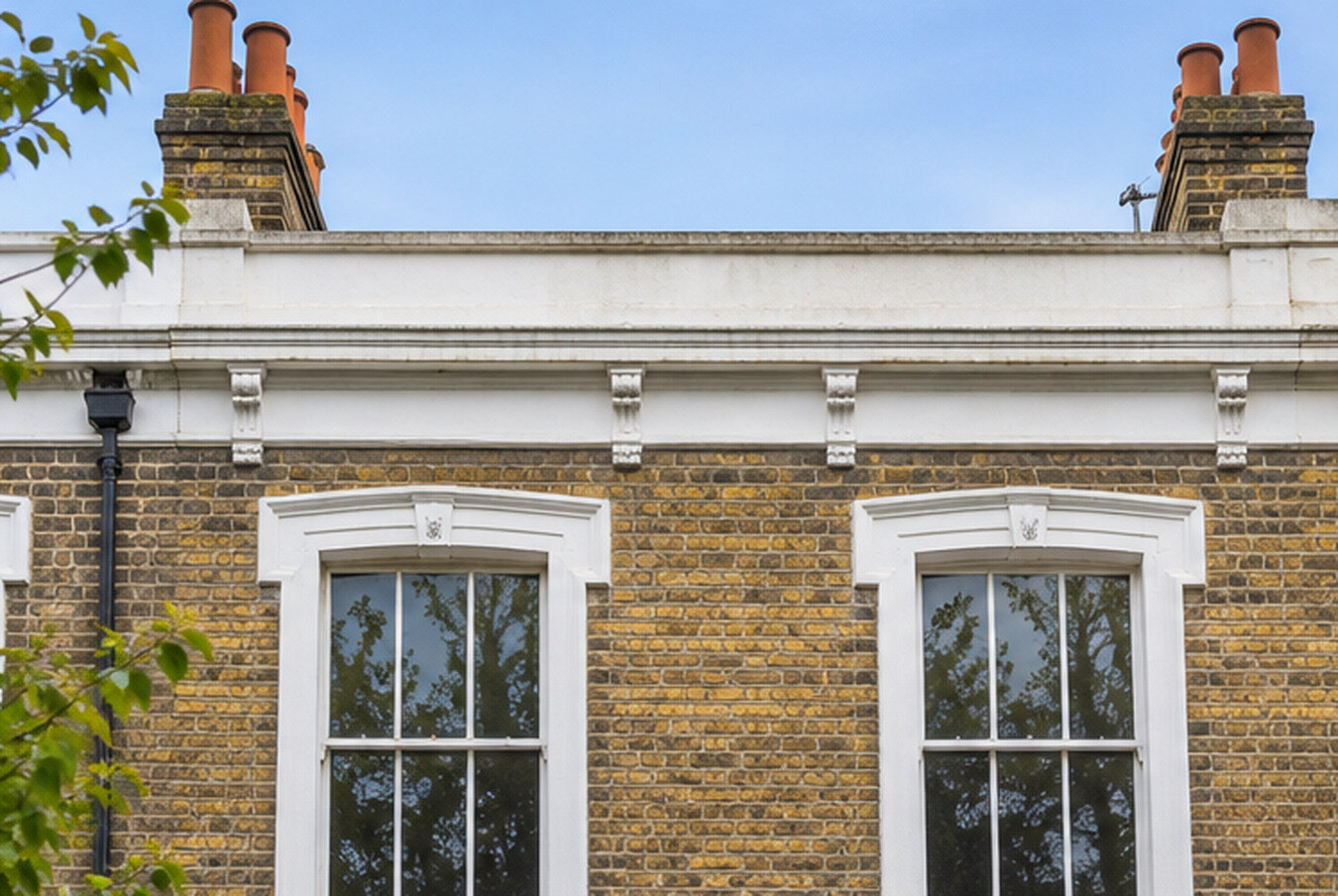
The difficulty for a buyer is that the valley is concealed by design. It cannot be seen from the street, and in most cases it cannot be seen during a standard survey either.
What a butterfly roof is
Also called a London roof, a V roof or an inverted gable. Instead of shedding water outward to gutters at the eaves, the roof slopes inward from both sides so that everything drains to a single valley running front to back.
Planning documents describe the arrangement plainly. A Camden Council planning letter on a terraced house refers to a parapet at roof level concealing a butterfly roof with a central valley running from front to rear.
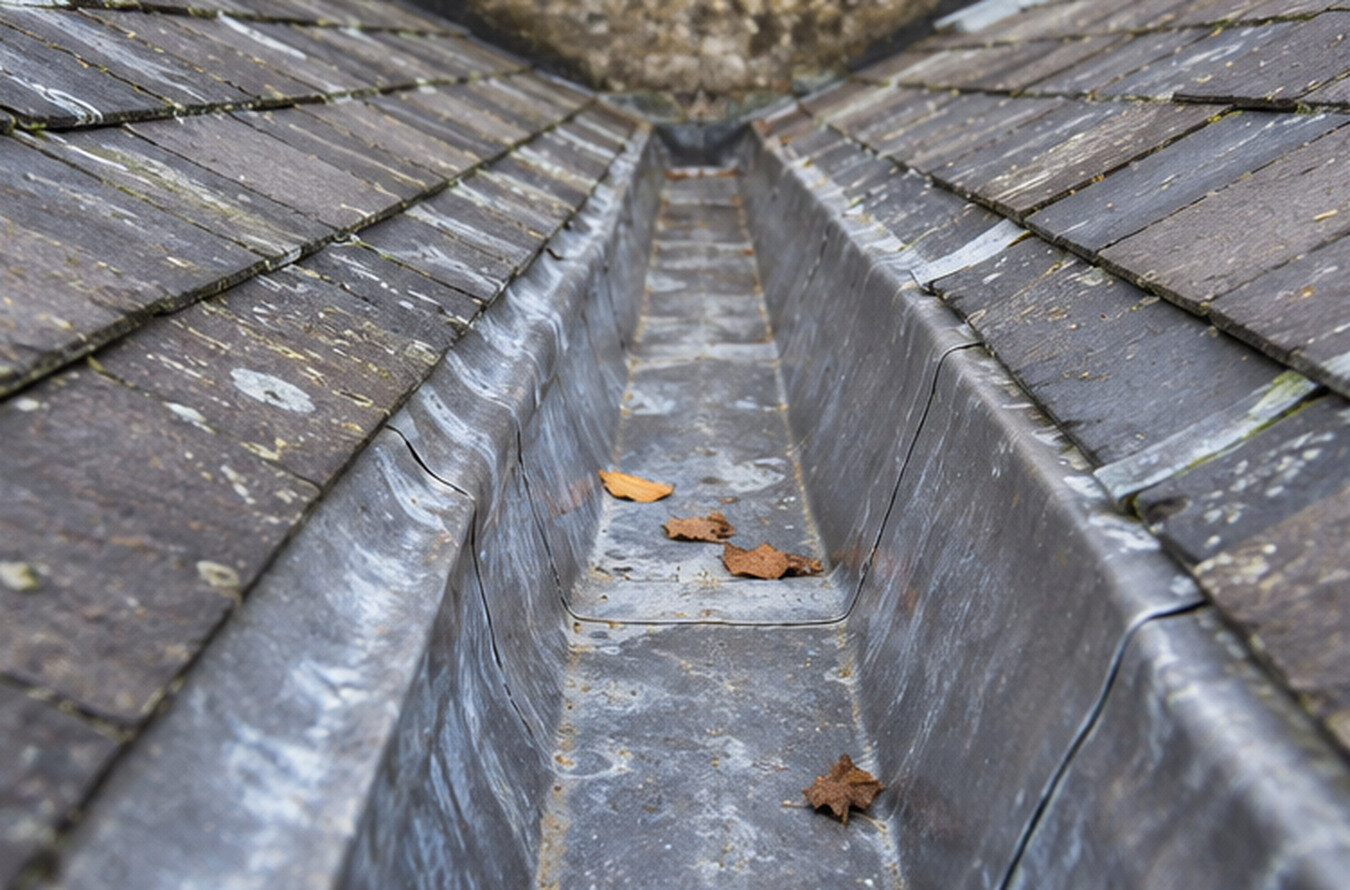
The valley is usually lead-lined, discharging through outlets into downpipes that are often internal or run behind the parapet. The slopes are typically Welsh slate, frequently patched over a century with other materials.
It is an elegant solution, and it has one weakness: every drop of water, every leaf, and every bit of silt on that roof arrives at one place.
Why they fail
Blockage. Leaves, moss and debris collect in the valley. Once the outlet blocks, water backs up. Because the valley sits between two slopes and behind a parapet, it has nowhere to overflow except inward, into the building.
Lead failure. Lead linings have a long but finite life. Joints fail, splits open at stress points, and old patching degrades. Ponding water accelerates it.
Parapet and flashing defects. The parapet is exposed on both faces and takes weather from every direction. Failed pointing, cracked copings and tired flashings at the junction with the valley all let water in.
No safety margin. A conventional pitched roof that leaks sheds water outward. A blocked butterfly valley has only one direction to go.
The practical consequence is that these roofs can leak quietly for a long time. Water runs along rafters, valley boards and the inside of the parapet before it appears on a ceiling, which is why the stain and the defect are usually in different places.
What your survey will and will not see
This is the part worth understanding before you instruct anyone.
A RICS Home Survey is a visual inspection carried out to a standard published by RICS, the Royal Institution of Chartered Surveyors. Roofs are inspected from ground level, from adjoining public property where accessible, and with the help of binoculars. Surveyors do not use ladders to reach hatches or surfaces well above ground.
On a two or three-storey terrace with a front parapet, a central valley sits outside all of that. The surveyor may get a partial view from a neighbouring window, a rear vantage point or an upper-floor window, and may not get one at all.
Where that happens, the report records the element as recorded as not inspected, with an explanation and, where the surveyor has concerns, a recommendation for further investigation. That is the system working correctly, not a corner being cut. Our guide to how roofs are inspected at each level sets out the scope.
What the surveyor can usually do
- Enter the roof space. At Level 2 and above the surveyor inspects the roof structure from inside. On a butterfly roof this is the most valuable evidence available without access equipment: staining and water marks on rafters, valley boards and the underside of the parapet, daylight at junctions, damp or decayed timber, and previous repairs.
- Look from any available vantage point. Rear elevations, upper windows, neighbouring aspects.
- Read the inside of the house. Ceiling and wall staining on the top floor, particularly along the line of the valley and around internal downpipes.
- Tell you what they could not check, which is the point of the NI record.
If you are buying one, do this
- Say it before the inspection. Tell the surveyor the property has a butterfly roof and that you want the valley addressed specifically, including whatever they can establish from the roof void. A named concern gets a named answer.
- Consider the level. A Level 3 Building Survey is the usual choice on a period terrace, and it carries a longer and more thorough inspection of the roof space along with analysis of causes and repair options. It still will not give the surveyor access to the valley.
- Get the valley looked at properly. Where the report flags concerns, or simply cannot reach the element, the options are:
- A specialist roof inspection. A specialist roof inspection focused on the valley, the parapet and the outlets.
- Drone inspection. Increasingly common in London and well suited to concealed valleys, since it photographs the whole roof in one visit. It is a visual inspection rather than a structural survey, and the better firms say so.
- Access equipment. The most thorough and the most expensive. Scaffolding a terraced house commonly costs more than the survey itself, and a ladder reaches only the eaves.
The government's guide to buying a home anticipates exactly this situation, noting that buyers may be advised to get a specialist to carry out a further assessment after a survey.
- Ask the seller. When was the valley last cleared, relined or repaired, and is there paperwork? Regular clearing is cheap maintenance; a relining is a significant job with a date attached.
Do not confuse it with the outrigger valley
London terraces often have a second valley, where the main roof meets the rear outrigger or back addition. It is a different element with a similar failure mode, and it is frequently the actual source of first-floor rear damp.
Several articles on this subject treat the two as one thing. If your report mentions a valley, check which one it means.
Shared valleys and party walls
On terraces the valley and the parapet frequently run between properties, and the boundary may sit along the middle of the valley.
That has two consequences. A neighbour's blocked outlet can become your water ingress. And any substantial repair may involve work at or across the boundary, which raises questions about responsibility and access.
Who owns and maintains what is set out in your title documents, and it is a question for your conveyancer rather than your surveyor. Worth raising early on a terrace, because the answer affects what a repair will cost you.
What drives the cost of putting it right
No two of these jobs are alike, so treat any headline figure you read with caution. What actually moves the number:
- Whether the fix is clearing and local patching, or full relining
- The length of the valley and the number of outlets
- Access, which on a terrace usually means scaffold
- Whether the parapet, copings and flashings need attention at the same time
- Whether internal downpipes are involved
- Listed status or conservation area constraints, which are common in this housing stock
- Whether timber below has decayed, which only becomes visible once work starts
Get the inspection first. Pricing a repair nobody has properly looked at produces numbers that move once someone gets up there.
Are they a reason not to buy?
No. Large parts of inner London sit under butterfly roofs and have done for 150 years. Maintained, they work.
What matters is knowing the condition before you commit, and recognising that this is the one element where a standard survey is least likely to give you an answer. A well-maintained valley with a maintenance history is unremarkable. An unknown valley on a property with top-floor ceiling staining is worth resolving before exchange.
Our guide to Victorian and period terraces covers the wider picture on this housing stock.
Frequently asked questions
What is a butterfly roof?
Two roof slopes pitching inward to a central valley gutter, usually concealed behind a front parapet wall. Common on Georgian and Victorian London terraces, and also called a London roof.
Why do butterfly roofs leak?
All the water reaches one valley. If the outlet blocks or the lead lining fails, water has nowhere to overflow except inward into the building.
Can a surveyor inspect a butterfly roof?
Often not directly. Roofs are inspected visually from ground level and any available vantage point, so a concealed valley is frequently recorded as not inspected, with further investigation recommended.
Does a Level 3 survey cover it?
It gives a longer and more thorough inspection, including the roof space, but it does not give the surveyor access to a concealed valley.
How do I get the valley checked?
A specialist roof inspection, a drone inspection, or access equipment. Drone is usually the quickest and least disruptive of the three.
Who is responsible for a shared valley gutter?
It depends on the title documents and where the boundary sits. Ask your conveyancer.
Are butterfly roofs expensive to maintain?
Routine clearing is inexpensive. Relining a valley is a significant job, which is why knowing its condition and history before you buy is worth the effort.
Get a survey quote
Tell us the property has a butterfly or parapet roof and we will pass it on, so the surveyor knows to address the valley specifically and to advise on what further inspection is worth arranging.