What Does a House Survey Include?
A house survey is a visual inspection of a property's condition. The surveyor inspects the outside and inside of the main building and any permanent outbuildings, the roof space, the visible parts of the services, and the grounds, then reports on the construction, the significant defects found and what they mean. What is covered in detail depends on which RICS level you commission.
The scope is not left to individual firms to decide. RICS, the Royal Institution of Chartered Surveyors, publishes the RICS Home Survey Standard, and every RICS Home Survey is carried out to it. That is why it is possible to say with some precision what you will and will not get.
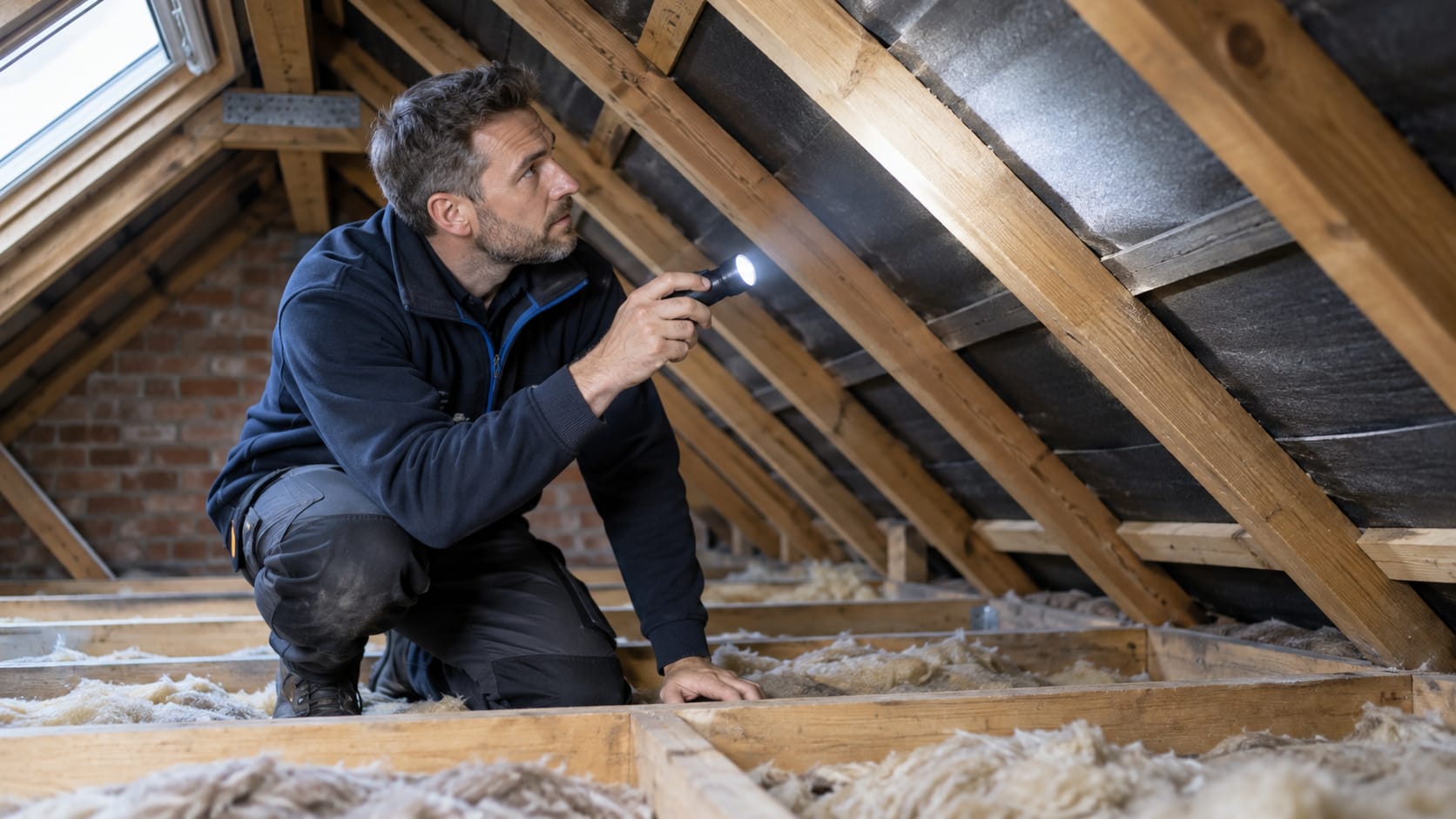
What the surveyor inspects
Across all three levels, the inspection covers:
- The outside of the building. Roof coverings, chimneys, rainwater goods, walls, pointing, windows, doors and external joinery, inspected from ground level and from adjoining public property where accessible.
- The inside. Ceilings, walls, floors, internal joinery, fittings, fireplaces and any visible signs of damp or movement.
- The roof space. How far this goes depends on the level, and it is one of the clearest differences between them.
- Visible parts of the services. Electricity, gas or oil, water, heating and drainage, so far as they can be seen.
- Permanent outbuildings. Garages and substantial outbuildings within the boundaries, where they are accessible and safe to inspect.
- The grounds. Boundaries, retaining walls and anything in the grounds that affects the property.
The surveyor also records the construction of the property and how it has been altered, which is often as useful as the defect list.
Where any part cannot be checked, the surveyor records that in the report and explains why. That is an important habit to look for when you read it.
What is included at each RICS level
The same element gets a different depth of treatment depending on the level you buy.
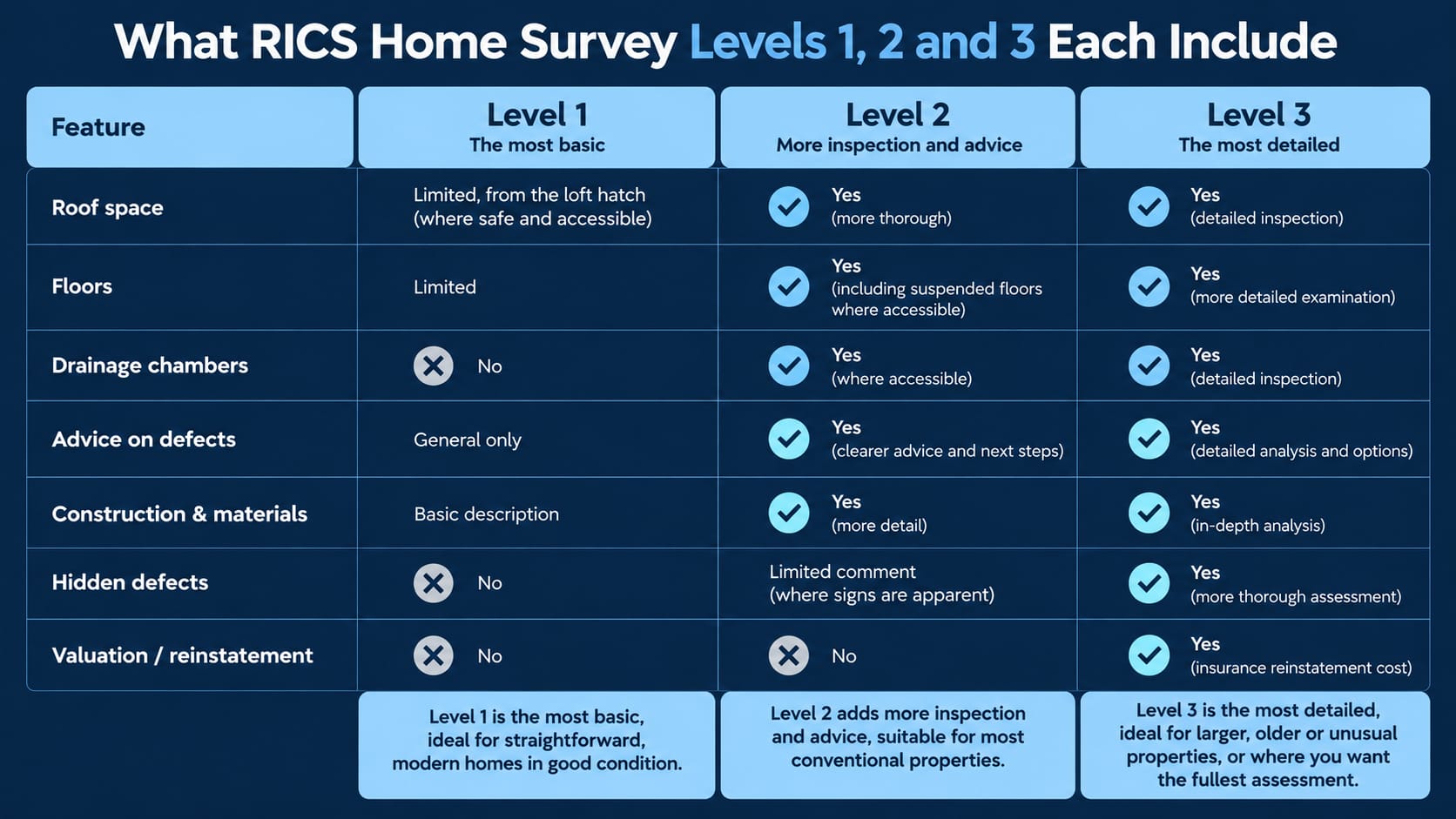
| Element | Level 1 | Level 2 | Level 3 |
|---|---|---|---|
| Roof space | Visual inspection of what can be seen from the access hatch | Surveyor enters the roof space and inspects the roof structure | Longer and more thorough inspection of the roof space |
| Floors | Surfaces of exposed floors, with a heel-drop test for excessive deflection | Adds an inverted head and shoulders inspection of subfloor areas where hatches or boards are unfixed and it is safe | Also lifts the corners of loose, unfitted carpets and coverings where practicable |
| Drainage chambers | Less extensive | More extensive drainage chamber inspection | More extensive drainage chamber inspection |
| Advice on defects | Notes defects, but generally does not advise on how to manage them | Advice on defects and the repairs or maintenance that may be needed | Repair options, a repair timeline, and the consequences of not carrying out the work |
| Construction and materials | Describes construction and condition | Describes construction and condition | Establishes how the property is built, what materials were used and how they will perform |
| Hidden defects | Not covered | Not covered | Describes potential problems posed by hidden defects |
| Valuation and reinstatement figure | Not included | Included in the survey and valuation version only | Not included as standard |
The practical read: a RICS Level 1 Home Survey tells you what is wrong.
The extra roof space and drainage work is the core of what a Level 2 HomeBuyer survey covers, along with advice on what to do about what is found.
A Level 3 Building Survey goes further again, into how the building is put together and what may be going on where the surveyor cannot see.
If you are weighing the two most common options, our guide to how the two levels compare works through it.
Get a survey quote
If you are not sure which level covers what you need, tell us about the property and we will help you work it through before you book.
What a house survey does not include
This is the part buyers most often get wrong, and it is worth reading properly before you commission.
The surveyor does not open up the building
No taking up fitted carpets, fitted floor coverings or floorboards. No moving heavy furniture. No emptying cupboards or roof spaces. No removing secured panels or hatches. No undoing electrical fittings. If something is hidden behind a fitted wardrobe, it stays hidden.
The services are not tested
Only the visible parts are inspected, and no specialist tests are carried out.
A visual inspection cannot assess the efficiency or safety of electrical, gas or other energy sources, cannot investigate plumbing, heating or drainage installations or whether they meet current regulations, and cannot assess the internal condition of any chimney, boiler or flue.
If you want to know whether the wiring is sound or the boiler has life left in it, that is a separate specialist check.
External wall systems are not inspected
For anyone buying a flat in a block, this matters.
Where the surveyor has concerns, they will recommend further investigation before you make a legal commitment, and until that is done they may not be able to give a valuation figure.
It is not an asbestos survey
The surveyor may assume no harmful or dangerous materials were used in construction.
If the inspection does identify a suspected asbestos containing material, the report must say so clearly, but you should not treat a home survey as a substitute for an asbestos survey.
It is not legal advice
The surveyor does not act as a legal adviser and does not comment on legal documents.
What they will do is flag issues for your conveyancer to pick up, and list documents worth requesting before you sign contracts.
It is not an EPC, and it is not a mortgage valuation
The government's guide to buying a home is clear that an Energy Performance Certificate only assesses the elements affecting energy efficiency and assumes they are all working correctly, and that a lender's valuation does not protect you if something goes wrong.
Where the surveyor cannot reach a firm conclusion, the report recommends further investigation, says why, says when it should happen and indicates who should do it.
That is the system working as intended, not a gap in the service.
How defects are reported
Findings are given condition ratings, which is what makes a report quick to triage:
- Condition rating 1. No repair is currently needed. Normal maintenance applies.
- Condition rating 2. Defects that need repairing or replacing, but are not serious or urgent.
- Condition rating 3. Defects that are serious, or that need to be repaired, replaced or investigated urgently.
- NI. Not inspected. The surveyor could not check a part of the property that the inspection would normally cover. If they are concerned about it, the report says what further investigation is needed.
Read the rating 3 items first, then the NI list. The NI list tells you what nobody has actually looked at.
Most reports also flag matters for your legal adviser and documents to request before exchange.
If you already have a specific worry, such as cracks in walls and what they can mean, say so before the inspection.
RICS advises telling the surveyor about particular concerns so they can address what matters to you.
What this means for London buyers
Much of London's stock is period, converted or altered, which changes what is worth paying to have covered.
In a converted flat, the surveyor's remit is the property you are buying, and the condition of the wider building and common parts may be reported only so far as it can be seen.
In a purpose-built block, remember that external wall systems fall outside the inspection, which is why cladding questions run on a separate track through your conveyancer and the managing agent.
On period terraces, loft conversions and rear extensions are worth flagging in advance.
The surveyor will want to look at how the work was done, and you will want your conveyancer checking that the consents exist.
How long it takes and what you get
The inspection generally takes between two hours and a full day depending on the size and complexity of the property, and longer for very large homes.
The written report follows afterwards, with the turnaround varying by firm.
Read it in full, then speak to the surveyor about anything you do not understand.
Reading condition ratings without that conversation is how buyers miss the point of a report they have already paid for.
Frequently asked questions
Does a house survey check the electrics?
Only visually, and only the parts that can be seen. The surveyor does not carry out specialist tests and cannot assess whether the electrical installation is safe or meets current regulations. A separate electrical inspection is needed for that.
Does a surveyor check for damp?
The surveyor looks for visible signs of damp and will report what they find and what they think is causing it. They are not carrying out a specialist damp investigation, and where the cause is unclear they will recommend further investigation.
Does the surveyor go into the loft?
At Level 2 and Level 3, yes, where there is safe access. At Level 1 the roof structure is inspected visually from the access hatch. At no level does the surveyor move or lift insulation, stored goods or other contents.
Will the surveyor move furniture or lift carpets?
No. The surveyor does not move heavy furniture or take up fitted carpets or floorboards. At Level 3 they will lift the corners of loose, unfitted coverings where it is practicable to do so.
Does a house survey include a valuation?
Not automatically. A valuation and a reinstatement figure are included in the Level 2 survey and valuation option. Level 1 and Level 3 do not include one as standard.
What is not inspected gets recorded, doesn't it?
Yes. Anything the inspection would normally cover but could not be checked is recorded as not inspected, with an explanation, and with advice on further investigation where the surveyor has concerns.
Is a survey the same as a snagging list on a new build?
No. A snagging inspection is about unfinished or defective work on a newly built home and is handled through the developer and warranty. A RICS Home Survey assesses condition.