Survey Condition Ratings Explained
Condition ratings are the traffic light scores used in a RICS survey report.
Rating 1 means no repair is currently needed.
Rating 2 means something needs repairing or replacing, but it is not serious or urgent.
Rating 3 means the defect is serious, or needs repairing, replacing or investigating urgently.
NI means the element was not inspected.
They are applied to individual parts of the property, not to the property as a whole.
The ratings at a glance
| Rating | What it means | What to do |
|---|---|---|
| 1 | No repair currently needed. Carry on maintaining the property normally. | Read the section anyway. It often explains how something is built and how to look after it. |
| 2 | Defects that need repairing or replacing, but are neither serious nor urgent. | Plan and budget. Consider getting a rough cost and check whether the issue may worsen if left. |
| 3 | Defects that are serious, or that need repairing, replacing or investigating urgently. | Act before exchange. Obtain the recommended further investigation or contractor quotations, then decide how you want to proceed. |
| NI | Not inspected. The surveyor could not check the element. | Read why it was not inspected and check whether the report recommends further investigation. |
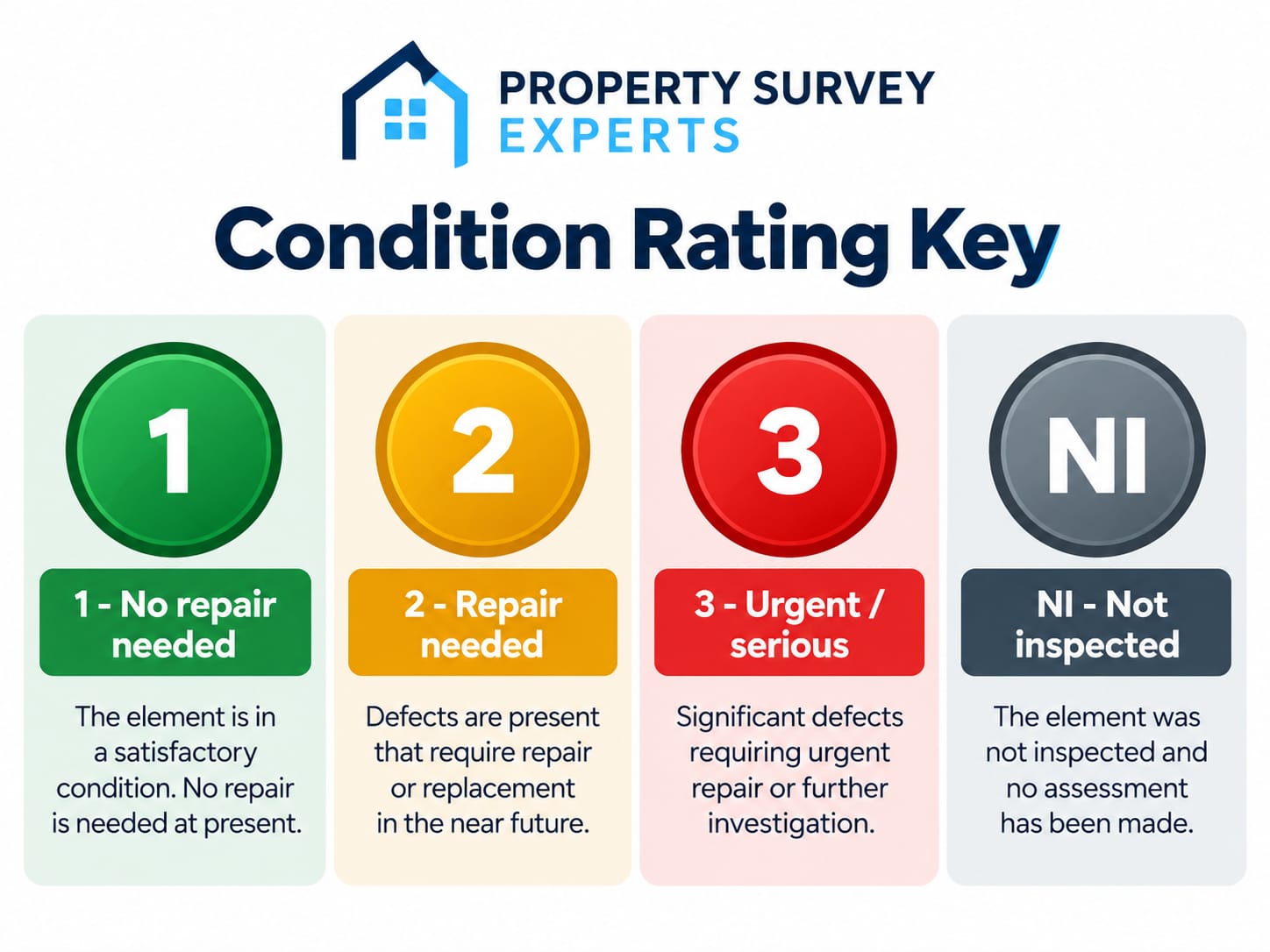
The condition-rating framework is defined by RICS, the Royal Institution of Chartered Surveyors. RICS sets the meaning of the standard condition ratings used in its Home Survey reports, while individual surveyors provide property-specific commentary and advice.
Condition rating 1
The element is in acceptable order and no repair is needed at present.
The property should continue to be maintained in the normal way.
A rating 1 is not a guarantee.
It reflects what the surveyor could inspect on the day, and normal maintenance is still assumed.
It is worth reading these sections rather than skipping them, because they can also explain the construction and condition of that part of the property, which can be useful when planning future maintenance or work.
Condition rating 2
Something needs repairing or replacing, but the surveyor does not consider it serious or urgent.
This is a rating buyers can be tempted to dismiss, but it is still worth reading properly.
A rating 2 can represent work that you may need to budget for during ownership.
Examples may include worn roof coverings, deteriorating pointing, ageing windows or other defects that require repair or replacement but are not regarded as serious or urgent.
Two useful questions to ask about every rating 2 are:
- Roughly what might this cost, and when is the work likely to be needed?
- Does the report suggest the defect could worsen or become more expensive if it is left?
A rating 2 is not automatically cheaper to resolve than a rating 3.
The rating describes the seriousness and urgency of the defect, not the eventual repair cost.
Condition rating 3
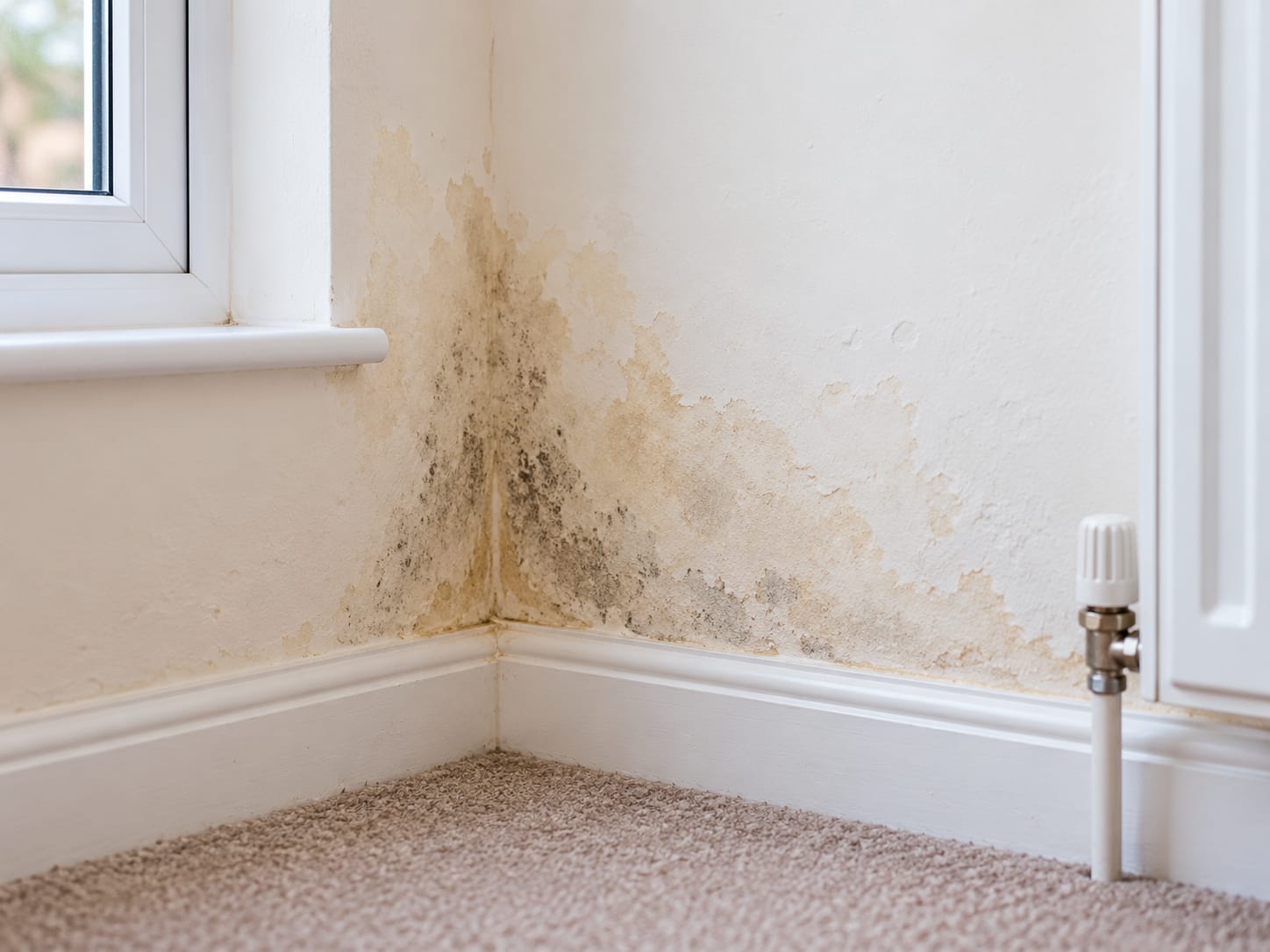
The defect is serious, or it needs repairing, replacing or investigating urgently.
A rating 3 is not automatically a reason to walk away from a purchase.
It is a reason to understand the issue properly before you become legally committed.
Purchases can still proceed where rating 3 items are identified, provided the buyer understands the issue, obtains appropriate further advice or quotations and decides how they wish to proceed.
Note the wording carefully.
A rating 3 can mean the surveyor has identified a serious defect, or that urgent further investigation is needed before the issue can be properly understood.
Those situations can lead to different next steps.
Structural cracking, for example, may receive a rating 3 where the findings are serious or require urgent further investigation.
If that is what your report flags, our guide to cracks in walls and what they can mean explains some of the issues surveyors consider.
What to do about a rating 3
Work through it in order.
Read the full entry, not just the colour
The surveyor should explain what they observed and what they believe it means.
Speak to the surveyor
The government's guide to buying a home advises buyers to read the report carefully and speak with the surveyor afterwards so they understand what the problems are, how serious they are and what the possible remedies may be.
You have already paid for that professional assessment, so use the opportunity to clarify anything you do not understand.
Get the further investigation if one is recommended
Where a rating 3 recommends further investigation, follow the report's advice.
Depending on the issue, this could involve an appropriately qualified structural engineer, electrician, drainage specialist, damp specialist or another relevant professional.
Get written quotations
RICS recommends obtaining quotations from at least two experienced contractors for identified repairs before making a legal commitment to buy.
Use properly insured contractors and get quotations in writing.
Decide what to do with the information
Where significant issues are identified, options may include asking the seller to carry out work, renegotiating the purchase price to take account of the issue, proceeding with the purchase in full knowledge of the work required, or withdrawing from the purchase.
Pass relevant issues to your conveyancer
Some survey findings require legal enquiries rather than building work.
Make sure relevant matters are passed to your conveyancer before exchange.
NI, or not inspected
NI means not inspected.
It does not mean there is no problem.
It means the surveyor was unable to inspect that particular element.
A home survey is primarily a visual inspection, so items that are inaccessible, concealed, unsafe to reach or otherwise outside the inspection may be recorded as not inspected.
The report should explain why the element was not inspected.
Where the surveyor has concerns, it should also explain whether further investigation is required and broadly who should undertake it.
When you read your report, consider the NI items alongside the rating 3 items.
Together, they highlight areas where there is either an urgent concern or where important information may still be missing.
If you want to understand why certain things fall outside the inspection in the first place, our guide to what a house survey actually inspects explains the limits of a visual inspection at each level.
The summary section can mislead you if read on its own
This is an important part of understanding a RICS report.
An individual survey element can contain several different parts.
RICS report guidance states that, within the detailed element boxes, the part with the worst condition rating is described first, followed by information about the condition of the other parts.
This means a single localised defect can sometimes dominate your first impression of an element if you only focus on the rating or summary.
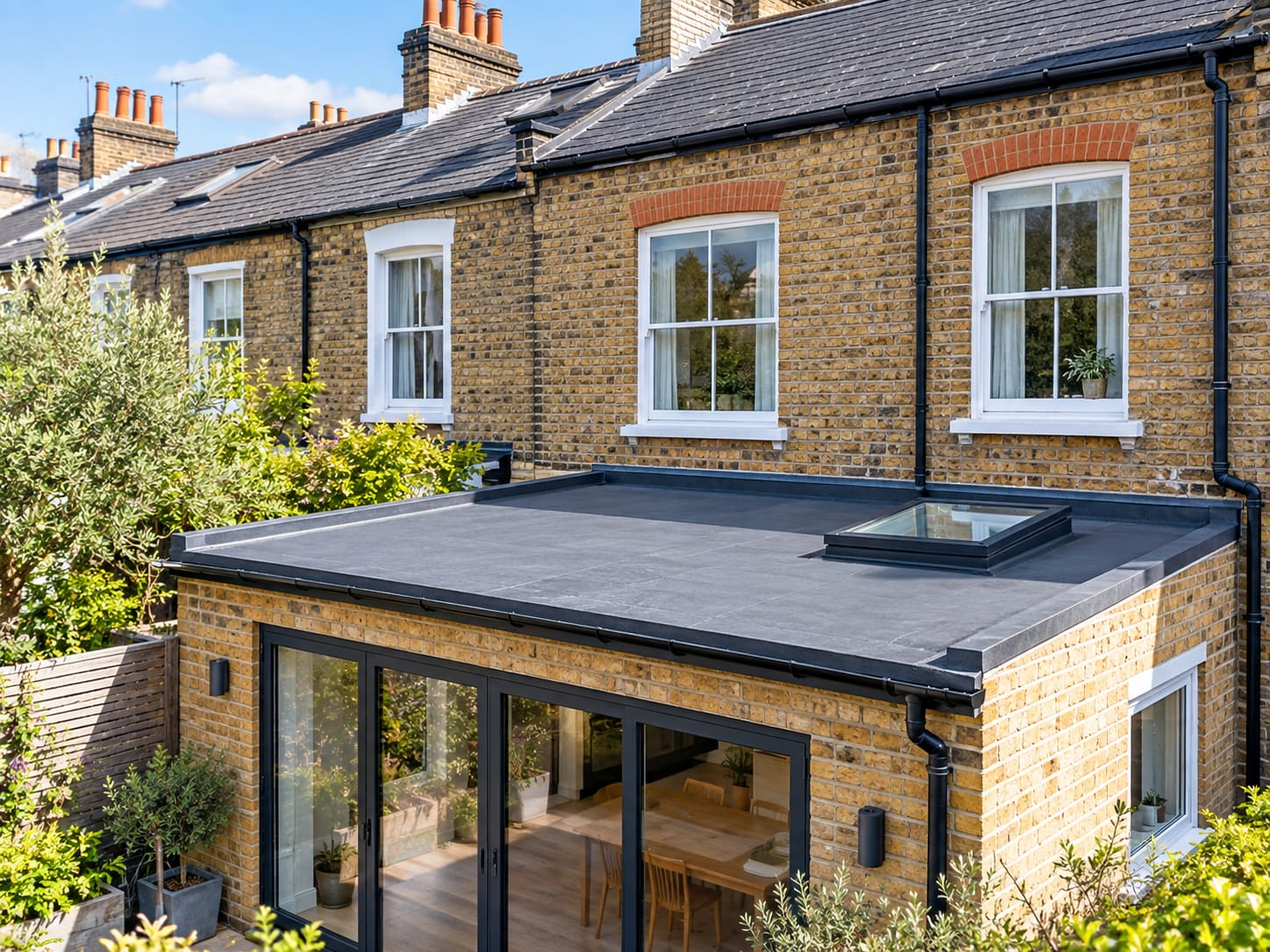
For example, a property could have a generally sound pitched roof but also have a flat roof over an extension that requires urgent attention.
The roof-covering element may therefore contain a rating 3 issue even though not every part of the roof has failed.
Read the detailed element section in the body of the report rather than assuming the rating means every part of that element is in the same condition.
The aim is to get a balanced view of the property.
Is there an overall rating for the property?
No.
Condition ratings are given to individual elements such as roof coverings, walls, windows, services and drainage.
There is no single condition rating for the entire property.
For an overall view, read the surveyor's written assessment and discuss the report with them rather than simply counting coloured boxes.
Do all three survey levels use ratings?
RICS Home Survey reports use condition ratings as part of their reporting framework, but the depth of inspection and advice differs significantly between the levels.
RICS Level 1 Home Survey
In a RICS Level 1 Home Survey, condition ratings are a central part of the report, alongside information about risks and the relative importance of defects.
RICS Level 2 Home Survey
In a RICS Level 2 Home Survey, the report provides more extensive inspection and includes advice about defects, repairs and future maintenance that may be required.
RICS Level 3 Home Survey
A Level 3 Building Survey provides substantially more written analysis alongside the condition ratings, including more detailed discussion of defects, repair options, priorities and potential consequences of not carrying out repairs.
What the ratings will not tell you
Cost
Condition ratings describe seriousness and urgency.
They do not tell you exactly what a repair will cost.
Where repair costs matter to your purchase decision, obtain appropriate contractor quotations.
Legal issues
The surveyor is not acting as your legal adviser.
Matters requiring legal investigation should be passed to your conveyancer.
Every risk affecting the property
General risks to the building, grounds or occupants may also appear elsewhere in the survey report rather than solely through an element's condition rating.
Anything the surveyor could not inspect
A condition rating reflects the inspection that could reasonably be carried out at the property on the day.
Anything that could not be inspected should be considered separately.
Reading only the coloured boxes means missing important parts of a report you have already paid for.
Frequently asked questions
What does condition rating 3 mean on a survey?
The defect is serious, or it needs repairing, replacing or investigating urgently. It does not automatically mean you should not buy the property. It means you should understand the issue and any recommended further investigation before becoming legally committed.
Is a condition rating 2 serious?
Not by the standard RICS definition. It indicates a defect that needs repairing or replacing but is not considered serious or urgent. It should still be read carefully and allowed for when planning future maintenance or expenditure.
What does NI mean?
NI means not inspected. The surveyor could not inspect that element. Read the explanation and check whether further investigation has been recommended.
Can I renegotiate after a condition rating 3?
Potentially. If a survey identifies significant issues, a buyer may ask the seller to address them, renegotiate the offer to reflect the likely cost of work, proceed with knowledge of the issue or withdraw. Written contractor quotations can provide useful evidence when discussing repair costs.
Does a rating 3 mean the property is unsafe?
Not necessarily. Rating 3 covers defects that are serious or require urgent repair, replacement or investigation. Read the full survey entry to understand exactly what the surveyor identified.
Do the ratings tell me how much repairs will cost?
No. Condition ratings describe seriousness and urgency rather than the exact cost of repairs. Cost estimates or contractor quotations should be obtained separately where needed.
Is there a rating for the whole property?
No. Condition ratings apply to individual elements of the property rather than producing one overall numerical rating for the home.
Get a survey quote
If you already have a report and are not sure how serious a finding is, the surveyor who inspected the property should be your first call because they have seen the property and written the report.
If you are arranging a survey and are not sure which level you need, Property Survey Experts can help you understand your options and connect you with an independent surveying professional.