House Survey Cost: UK Prices by Survey Level
As a broad budgeting guide, allow roughly £300 to £900 for a RICS Level 1 Home Survey, £400 to £1,000 for a Level 2 survey, and £600 to £1,500 or more for a Level 3 Building Survey.
These are indicative ranges, not an official RICS price list or a quote for your property. Fees can fall outside them. Check the total payable, including VAT where applicable, before comparing quotations.
A lender’s mortgage valuation is separate. Some mortgage products include it without a separate charge; otherwise, check the lender’s fee.
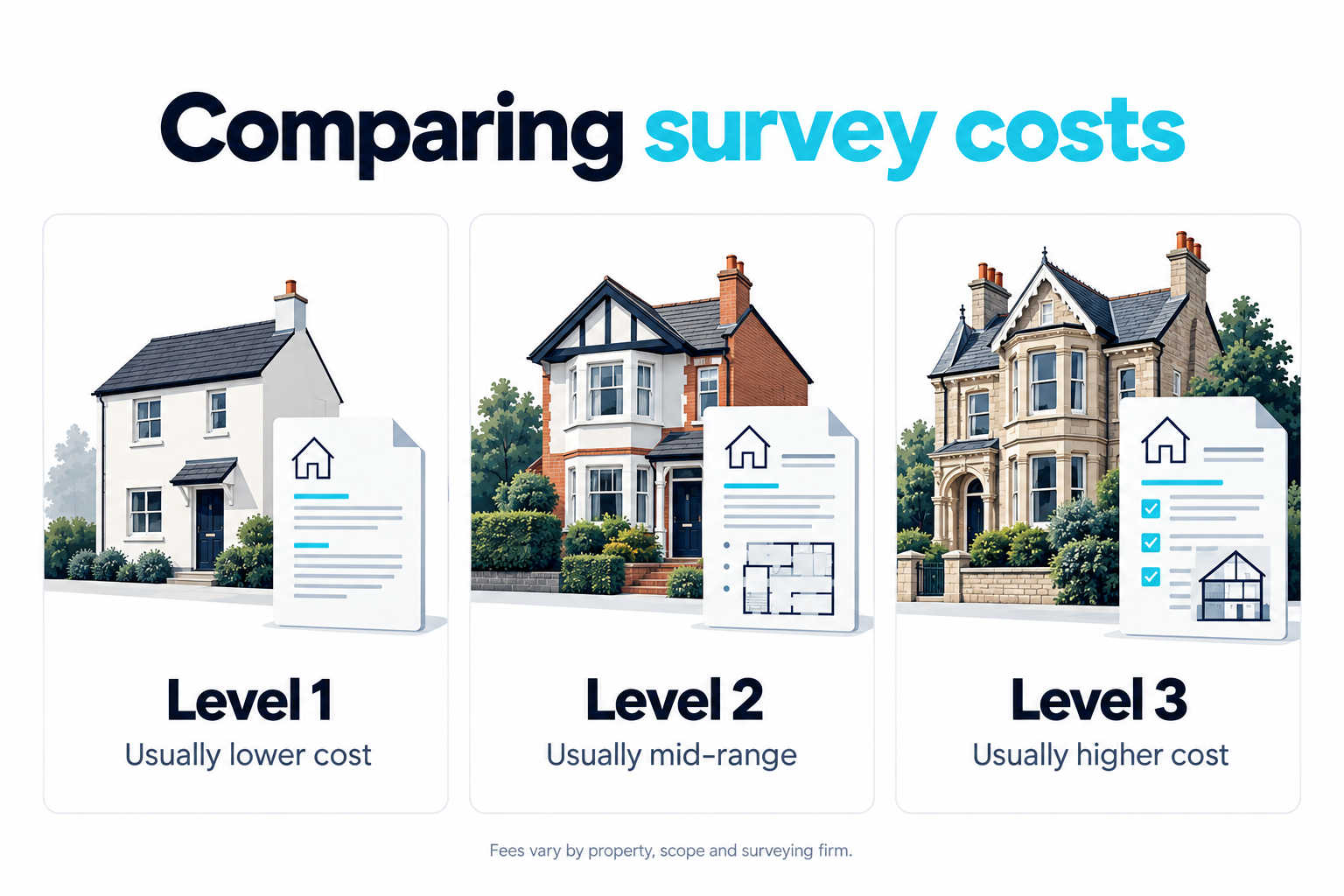
What a survey costs, by level
| Survey type | Indicative budgeting range | Generally suited to |
|---|---|---|
| Level 1 Home Survey, previously called a Condition Report | £300 to £900 | Conventional homes built from common materials and in good condition |
| Level 2 Home Survey, survey only | £400 to £1,000 | Conventional property in reasonable condition, simple in form and layout |
| Level 2 Home Survey, survey and valuation | Request a quote for the combined service; do not assume valuation is included in a survey-only fee | Buyers who also want a market valuation and insurance reinstatement figure |
| Level 3 Building Survey | £600 to £1,500+ | Larger, older, run-down, unusual or altered property, or purchases where major works are planned |
| Lender’s mortgage valuation | Check the lender’s charges; sometimes included with the mortgage product | A limited assessment for the lender, rather than a condition survey for the buyer |
The appointed surveying firm confirms the scope and fee once it has the property details. These broad ranges should not be treated as minimum or maximum charges.
Why published averages disagree with each other
Search this question and you will find different averages. That does not necessarily mean one source is wrong.
Published figures may cover different survey levels, property sizes, locations and time periods. Some reflect advertised quotes; others may reflect bookings or a particular provider’s customers. VAT and valuation services may also be treated differently.
Without checking the methodology, you cannot assume two headline averages measure the same thing.
Use averages as background context. The useful number is a written quote for your property, and the useful comparison is between firms offering the same level and scope of service.
RICS gives broad guidance rather than a national rate card: Level 1 generally sits at the lower end, starting at a few hundred pounds, while more extensive services can cost over £1,000.
What you are actually paying for
RICS explains that a surveyor’s quotation reflects the time needed to provide the required service and associated business costs, including travel and overheads.
That time includes the inspection, preparation of the report and the advice included in the agreed service.
A Level 3 generally involves a more extensive inspection and analysis than a Level 2 on the same property. It considers the building’s construction, defects, repair options and the consequences of leaving problems unresolved. Level 2 also includes advice on repairs and maintenance, but at a different depth.
Fees can also reflect a firm’s pricing structure and the property’s characteristics. They are not determined by inspection time alone.
Repair estimates are not automatically included. Some surveyors offer cost advice with a Level 3 survey by agreement. Contractor quotes are still needed before commissioning work.
Our guide to what a house survey includes explains what falls inside and outside the inspection.
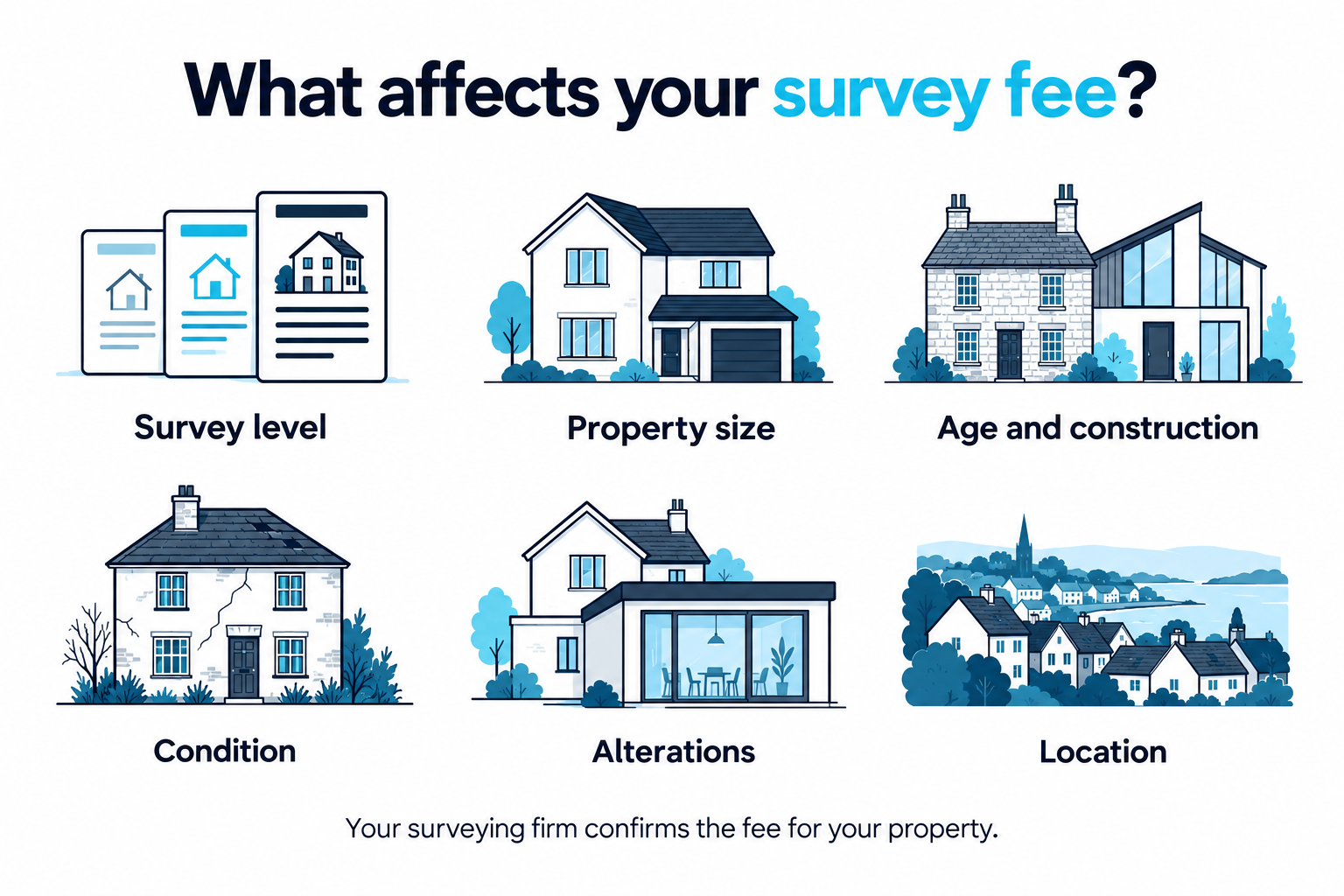
What moves a quote within the range
Size. More floor area, rooms and outbuildings can mean more inspection and reporting work.
Age and construction. Traditional or unusual construction can require additional experience and assessment. Age alone does not determine the fee.
Alterations. Loft conversions, extensions and structural openings can increase complexity and raise matters for the surveyor and conveyancer to investigate.
Condition. Visible defects may require more assessment and explanation.
Access. Access arrangements can affect scheduling and what can be inspected. Restricted loft access or locked outbuildings may result in inspection limitations rather than simply a longer visit.
Property value. Some firms use property-value bands as part of their pricing. Ask how the quote has been calculated if this is unclear.
Location. Local pricing, travel and business overheads can affect the fee.
Turnaround. Some firms charge more for an expedited service. Confirm any additional charge and the promised delivery date before booking.
Level 2 and Level 3 in more detail
Level 2 is commonly considered for conventional properties in reasonable condition. It comes in two versions, which matters when comparing quotes.
The survey-only version provides information about condition and advice on repairs and maintenance. The survey-and-valuation version also includes a market valuation and an insurance reinstatement figure.
Check which version you are being quoted for before deciding that one firm is more expensive. Do not assume a valuation is included or that every firm charges the same supplement.
For buyers in the capital, our guide to Level 2 survey costs in London provides more local detail.
Level 3 covers a wide variety of properties, so quotations can vary considerably. A smaller, relatively straightforward property and a large period house with cellars, outbuildings and extensive alterations may require very different amounts of work.
Our guide to Level 3 survey costs in London explains the local considerations in more detail.
Regional variation
National ranges cannot tell you exactly what a survey will cost in your area.
Local business costs, travel, availability and the particular property all affect quotations. A complex London period house may sit well above the broad starting figures shown here, but location alone does not determine the price.
If you are buying in the capital, our guide to house survey costs in London sets out the local budgeting ranges and factors to consider.
A note for buyers in Scotland
The buying process differs in Scotland. Sellers normally arrange a Home Report before marketing, subject to exemptions.
That means the buyer’s starting point is different from commissioning a survey in England, Wales or Northern Ireland. Discuss any need for additional inspection or valuation advice with the relevant professionals.
Watch for these when comparing quotes
The total payable. Ask for the complete price, including VAT where applicable and any agreed extras. Do not compare one firm’s total with another firm’s headline fee.
Which level and version. A Level 2 survey only and a Level 2 survey and valuation are different services.
What is included after the report. Confirm how you can discuss the findings, what follow-up is included and whether additional services carry a charge.
Turnaround. Ask when the inspection can take place and when the written report should arrive.
Who is doing the work. RICS Home Survey reports should be completed by a RICS member with appropriate experience. Relevant designations include AssocRICS, MRICS and FRICS. Where the service includes a valuation, check that the surveyor is also a RICS Registered Valuer.
Relevant experience. Ask about experience with your property’s age, construction and any unusual features.
Inspection limitations and extras. Check what is included, what access is needed and whether specialist investigations would be separate instructions.
RICS recommends shopping around and asking different firms for quotes. You do not have to appoint the firm suggested by your bank or estate agent.
Compare the service and competence alongside the price.

Where the survey sits in your buying budget
A survey sits alongside other buying costs, such as conveyancing, searches, insurance, moving expenses and any property transaction tax that applies.
Its particular purpose is to help you understand the property’s condition before making a legal commitment.
If you are weighing the fee against other expenses, our guide to whether a house survey is worth it looks at that decision and the circumstances in which a different inspection may be more useful.
Confirm payment and cancellation terms when you instruct the surveying firm. You pay the appointed firm directly, and the choice of whom to appoint remains yours.
Frequently asked questions
How much does a house survey cost in the UK?
As an indicative budgeting guide, allow roughly £300 to £900 for Level 1, £400 to £1,000 for Level 2 and £600 to £1,500 or more for Level 3. These are not official fixed prices. The property, location and agreed scope determine the quote, and you should confirm the total including VAT where applicable.
How much is a survey on a house?
For a conventional house in reasonable condition, a Level 2 may be appropriate, with a broad indicative range of £400 to £1,000. Older, altered, unusual or more complex properties may need Level 3. Ask a surveyor which service suits the property before comparing fees.
Why do survey quotes vary for the same house?
Firms may allow different amounts of professional time, have different overheads or include different services. Check the survey level, valuation option, follow-up support, turnaround and total price before comparing.
Is VAT included in survey fees?
Ask the firm to confirm the total payable and whether VAT applies. Do not assume every published range or headline figure uses the same basis.
Does a house survey include a valuation?
The Level 2 survey-and-valuation option includes a market valuation and an insurance reinstatement figure. A survey-only Level 2 does not. Level 1 and Level 3 do not include a market valuation as standard; discuss any additional service before booking.
Is the mortgage valuation the same thing?
No. It is a limited assessment for the lender’s purposes and does not provide the same information about condition as a home survey. It may not involve a physical inspection.
Do I pay before or after the survey?
Payment arrangements vary. Some firms require payment when booking or before inspection. Confirm payment and cancellation terms before instructing.
Does a more expensive survey mean a better one?
Not necessarily. Compare the level and scope, the surveyor’s relevant experience and the support included after the report. The cheapest quotation is not automatically the best value either.