Level 1 vs Level 2 Survey: Which Do You Need?
Both surveys describe the property's condition and flag serious, urgent or dangerous problems. A Level 2 adds three things a Level 1 does not do: it helps you decide whether you need extra advice before committing to the purchase, it helps you budget for repairs, and it advises on the ongoing maintenance the property will need.
That is the whole difference, stated the way RICS states it. Everything below explains what it means in practice.
The short version
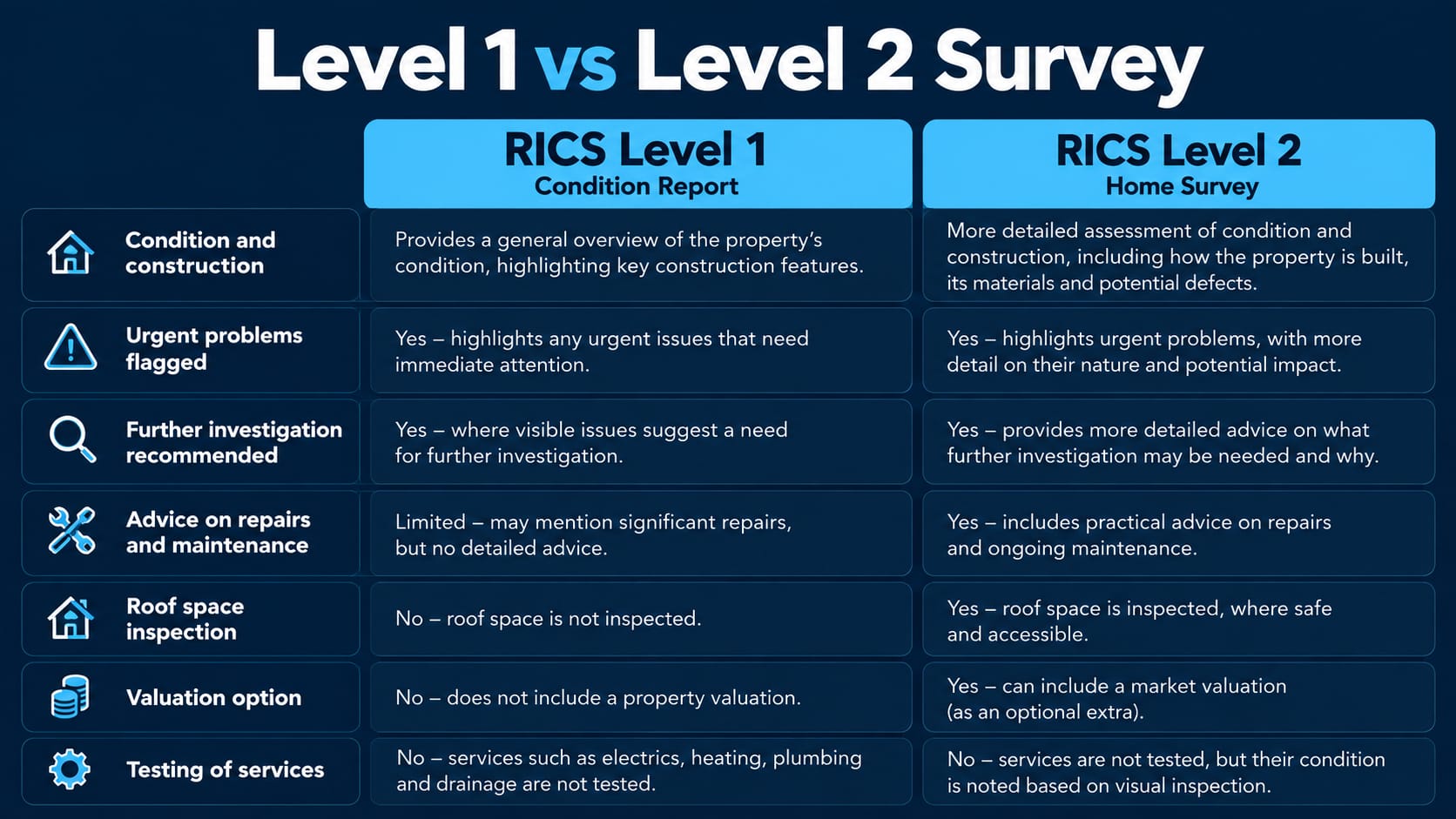
| Feature | Level 1 (Condition Report) | Level 2 (HomeBuyer) |
|---|---|---|
| Describes construction and condition | Yes | Yes |
| Flags serious, urgent or dangerous problems | Yes | Yes |
| Recommends further investigation where needed | Yes | Yes |
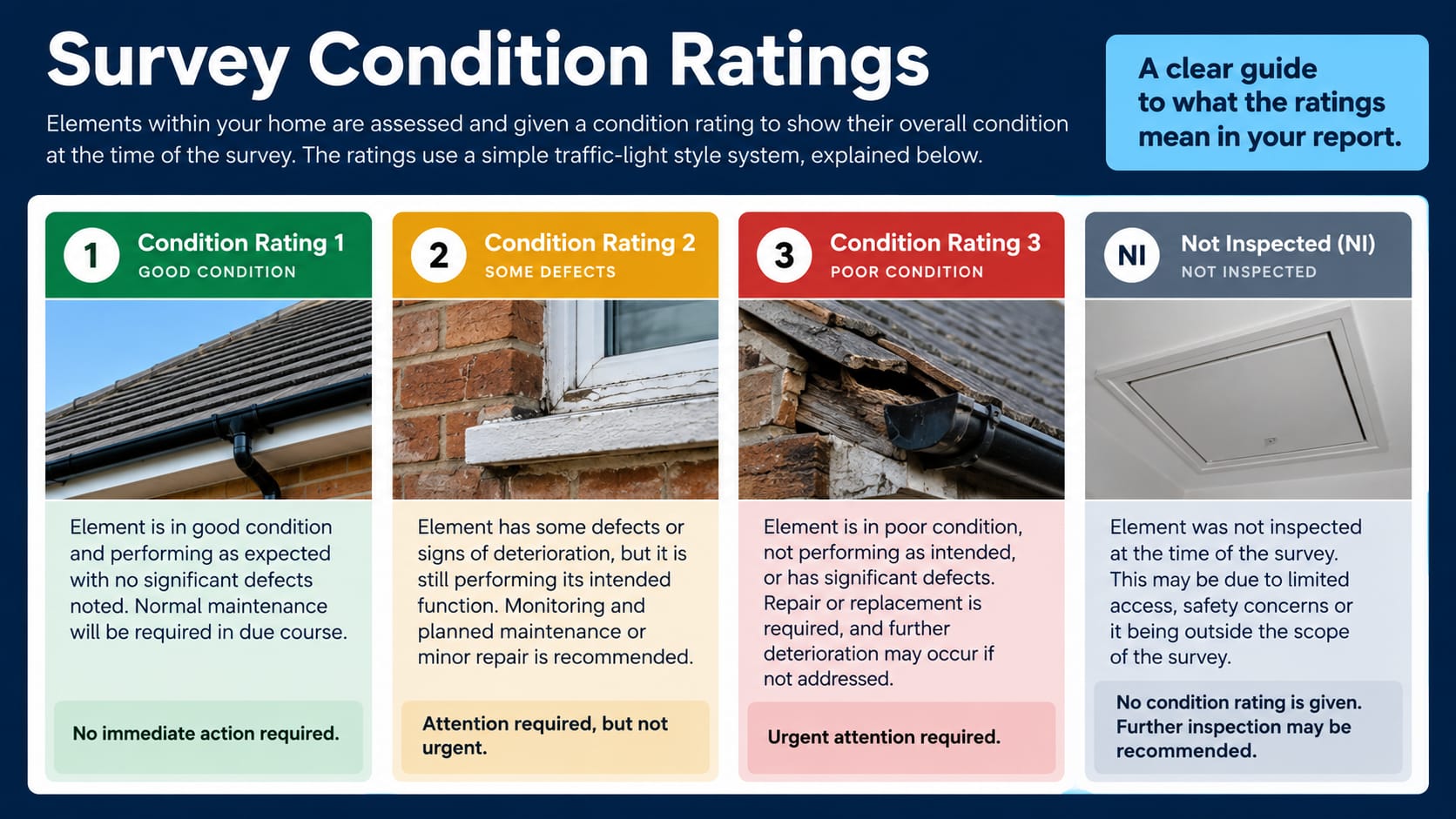
| Traffic light condition ratings | Yes | Yes |
| Helps you decide if you need extra advice before committing | No | Yes |
| Helps you budget for repairs or restoration | No | Yes |
| Advises on future ongoing maintenance | No | Yes |
| Inspects concealed areas such as roof spaces and cellars | Not to the same extent | Yes, where safe to do so |
| Market valuation and reinstatement figure | No | Only in the survey and valuation version |
| Tests of the building fabric or services | No | No |
Note the last row. Stepping up to Level 2 does not buy you testing. Neither level tests anything. Level 2 is a more extensive visual inspection, not a different kind of inspection.
For the full detail of what a house survey includes at each level, we have a separate guide.
What a Level 1 survey gives you
The levels are a standardised framework published by RICS, the Royal Institution of Chartered Surveyors.
RICS sets a standardised minimum framework for each survey level, although the exact service and any additional features can vary between firms.
A Level 1, still often called a Condition Report, includes:
- A visual inspection, less extensive than Level 2 or Level 3
- Traffic light ratings for the condition of different parts of the building, the services and the grounds
- A summary of risks to the building, to people and to the grounds
- An assessment of the relative importance of the defects and problems found
- A recommendation for further investigation where the surveyor cannot reach a confident conclusion
It is not a token document. It will tell you if something is seriously wrong.
What it does not do is tell you what to do about it. A RICS Level 1 Home Survey does not include advice on repairs or ongoing maintenance, and it does not include a valuation.
RICS says this plainly.
You get a clear picture of the defects identified and their relative importance, but without the more detailed repair and ongoing maintenance advice provided at Level 2.
What a Level 2 survey adds
A RICS Level 2 HomeBuyer survey keeps everything in Level 1 and adds three capabilities.
1. It helps you decide whether you need extra advice before you commit
Level 1 tells you a defect exists.
Level 2 helps you work out whether it is the kind of defect that needs a specialist opinion before you exchange contracts.
That is a materially different position to be in when you are days from a legal commitment.
2. It helps you budget
Level 2 is designed to let you plan for repairs or restoration.
If a roof is near the end of its life, this is the level that gives you more information to help you understand what repairs or further advice may be required.
3. It advises on ongoing maintenance
Not just what is wrong now, but what the property will need looking after over the years ahead.
There is also a practical inspection difference.
At Level 2 the surveyor inspects concealed areas that occupiers normally open or use, such as roof spaces, basements and cellars, where it is safe to do so.
The inspection covers the building, its services and the grounds more extensively, though still without any testing.

Survey only, or survey and valuation?
Level 2 comes in two versions, and this catches people out when comparing quotes.
Level 2 survey only
Condition and advice, no valuation.
Level 2 survey and valuation
The same, plus the surveyor's professional opinion on market value and an insurance reinstatement figure to help you avoid under-insuring or over-insuring.
If one quote looks unexpectedly higher than another, check which version you are being offered before you assume one firm is expensive.
Where the service includes a valuation, the surveyor should also be an RICS Registered Valuer.
Level 1 does not offer a valuation option at all.
The price gap, and whether it is worth it
This is usually the real question. Budgets are stretched at this point in a purchase.
In London a Level 1 typically starts from around £400, while a Level 2 generally runs from about £600 to £1,200 depending on the property.
Our guide to what each level costs in London breaks that down.
So the step up is often a couple of hundred pounds, against a purchase measured in hundreds of thousands.
For that, you move from knowing a problem exists to getting more information about whether further advice is needed, what repairs or maintenance may be required and what you may need to budget for over time.
For many buyers, the additional information can be useful when deciding which survey level is appropriate.
That said, do not buy a level you do not need.
Level 1 exists for a reason, and there are properties it fits.
Get a survey quote
Not sure which level fits? Tell us about the property, its age, condition and whether it has been altered, and we will help you think it through before you book.
When Level 1 genuinely makes sense
Level 1 is aimed at conventional houses, flats and bungalows built from common building materials and in good condition.
In practice it is worth considering when most of the following are true:
- The property is modern or recently built
- It has not been extended, converted or structurally altered
- It is built conventionally, with no unusual materials or construction
- It presents no visible signs of damp, movement or disrepair
- You are not planning works after completion
- You want a professional check rather than a repair and maintenance plan
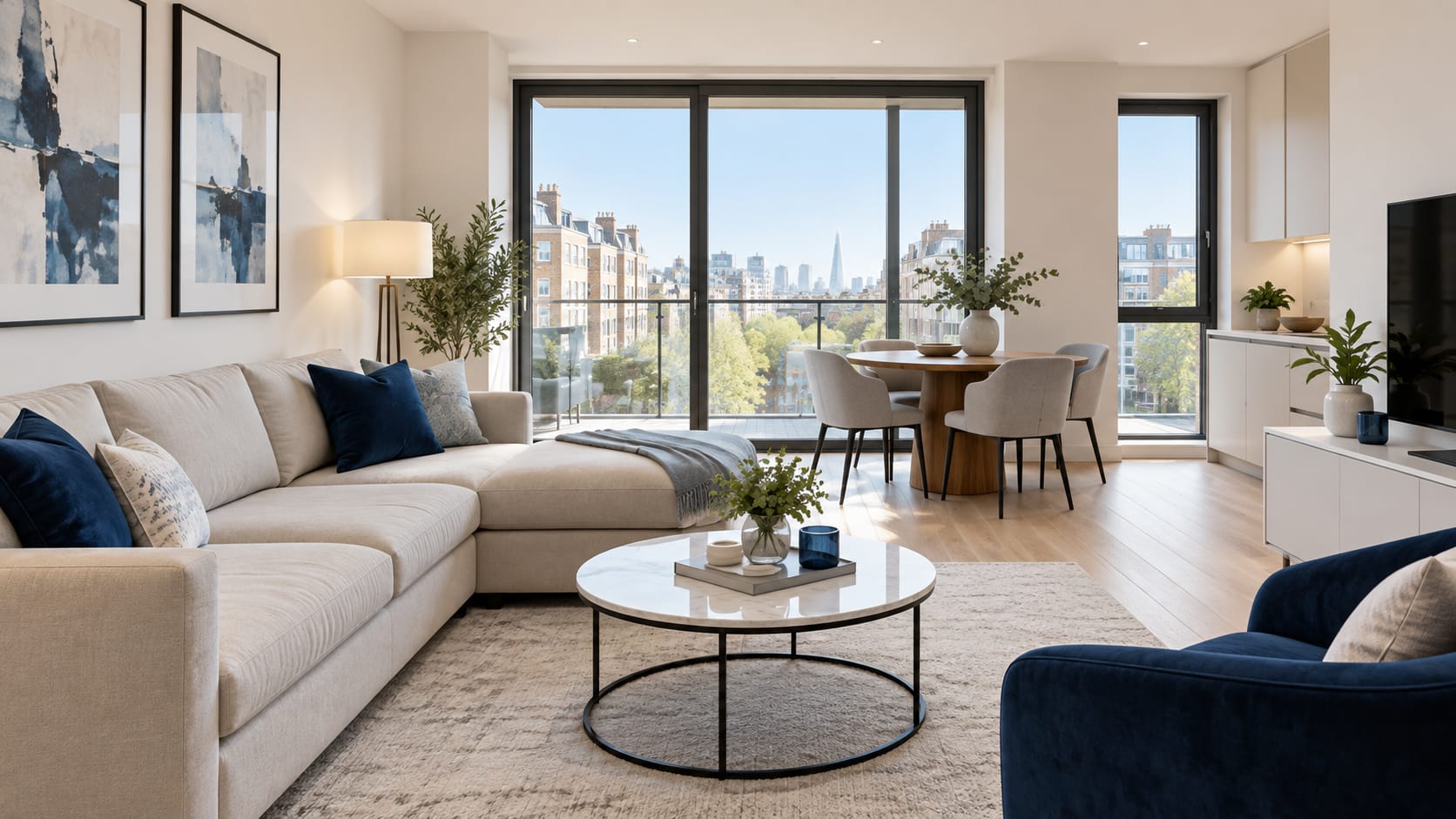
A well-kept modern flat with no alterations is a fair Level 1 candidate.
One common case deserves its own note.
On a new build, a Level 1 can be reasonable, because a brand new property in good order is close to the scenario the level was written for.
Bear in mind that defects and unfinished work on a new home are usually handled through a snagging inspection and the developer's warranty rather than through a RICS Home Survey, so consider which of the two you actually need.
When Level 2 is the better call
Lean to Level 2 where any of these apply:
- The property has been extended, converted or had structural openings formed
- There are visible defects, damp staining, cracking or a tired roof
- The property has been empty, let out or poorly maintained
- You want to understand what you may be spending on it over the next few years
- You want a valuation or a reinstatement figure
- You simply do not know enough about the property to judge
RICS advises describing the property to a surveyor before booking, and the government's guide to buying a home says the same: speak to a surveyor about what level is recommended for your property.
It costs nothing to ask and it is a useful way to reduce the risk of choosing an unsuitable survey level.
A word on property age
You will see it claimed online that RICS recommends Level 2 for homes built after a particular year.
RICS guidance contains no age threshold of any kind.
What RICS actually says is that the appropriate level depends in most cases on the age, size, condition, complexity and originality of the property.
Age is one factor of five.
Age does matter in one specific respect, though.
Properties built before 1919 are constructed differently from modern housing, and the government's buying guide is clear that you should make sure your surveyor is qualified to assess such buildings.
That is a question about the surveyor's competence, not about which level to buy.
If your property is older or heavily altered
Some readers arrive at this comparison having already ruled out the right answer.
If the property is large, older, run down, unusual or altered, or if you are planning major works, the relevant comparison may not be this one.
Read Level 2 against Level 3 instead.
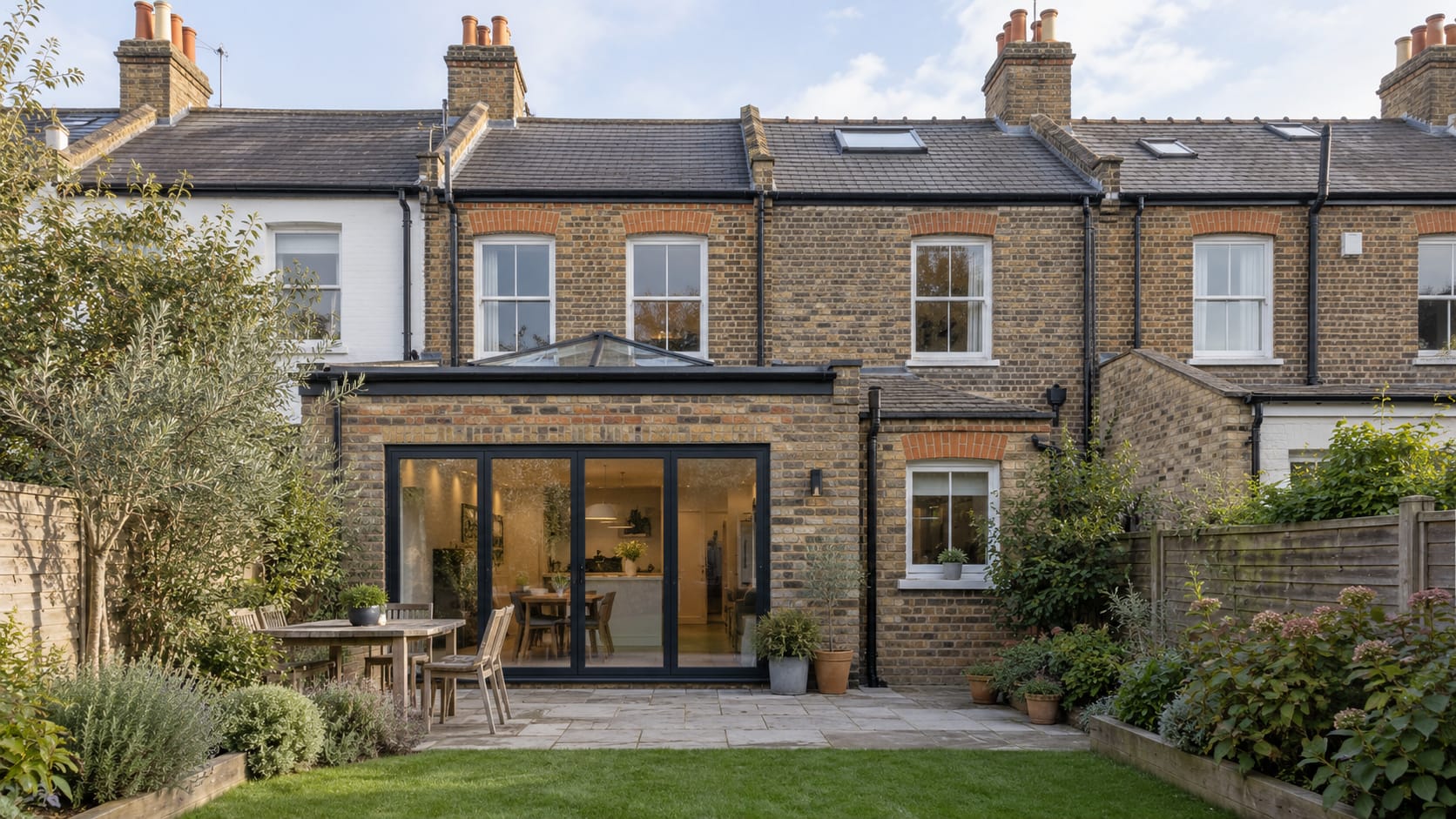
Much of London's housing stock is period, converted or extended, so this applies to a good share of buyers in the capital.
Frequently asked questions
What is the main difference between a Level 1 and Level 2 survey?
Level 2 adds advice. Both describe condition and flag serious problems, but Level 2 also helps you decide whether further advice may be needed before committing, helps you budget for repairs and advises on ongoing maintenance.
Is a Level 1 survey worth it?
For a modern, unaltered, conventionally built property in good condition, it can be. For an older, altered or visibly defective property, the additional inspection and advice provided at Level 2 may be more appropriate.
Does a Level 1 survey include a valuation?
No. A valuation is available as part of the Level 2 survey and valuation service.
Does a Level 2 survey test the electrics or the boiler?
No. Neither level carries out specialist tests of the building fabric or services. Both are visual inspections, and specialist testing is a separate instruction.
Is a Level 1 enough for a new build?
It can be for a new property in good condition. Also consider whether a snagging inspection would better address your concerns, since unfinished or defective work on a new home is generally dealt with through the developer and warranty process.
Can I upgrade from Level 1 to Level 2?
Discuss this with the surveyor before the inspection because the selected level determines the scope of the inspection. If the inspection has already been carried out to Level 1 scope, moving to Level 2 may require further inspection. Check with the surveyor before the original inspection wherever possible.
Which level do most buyers choose?
Level 2 is commonly commissioned because it provides a more extensive inspection and additional advice compared with Level 1. The appropriate choice should still depend on the individual property and the buyer's needs.