When to Book a House Survey
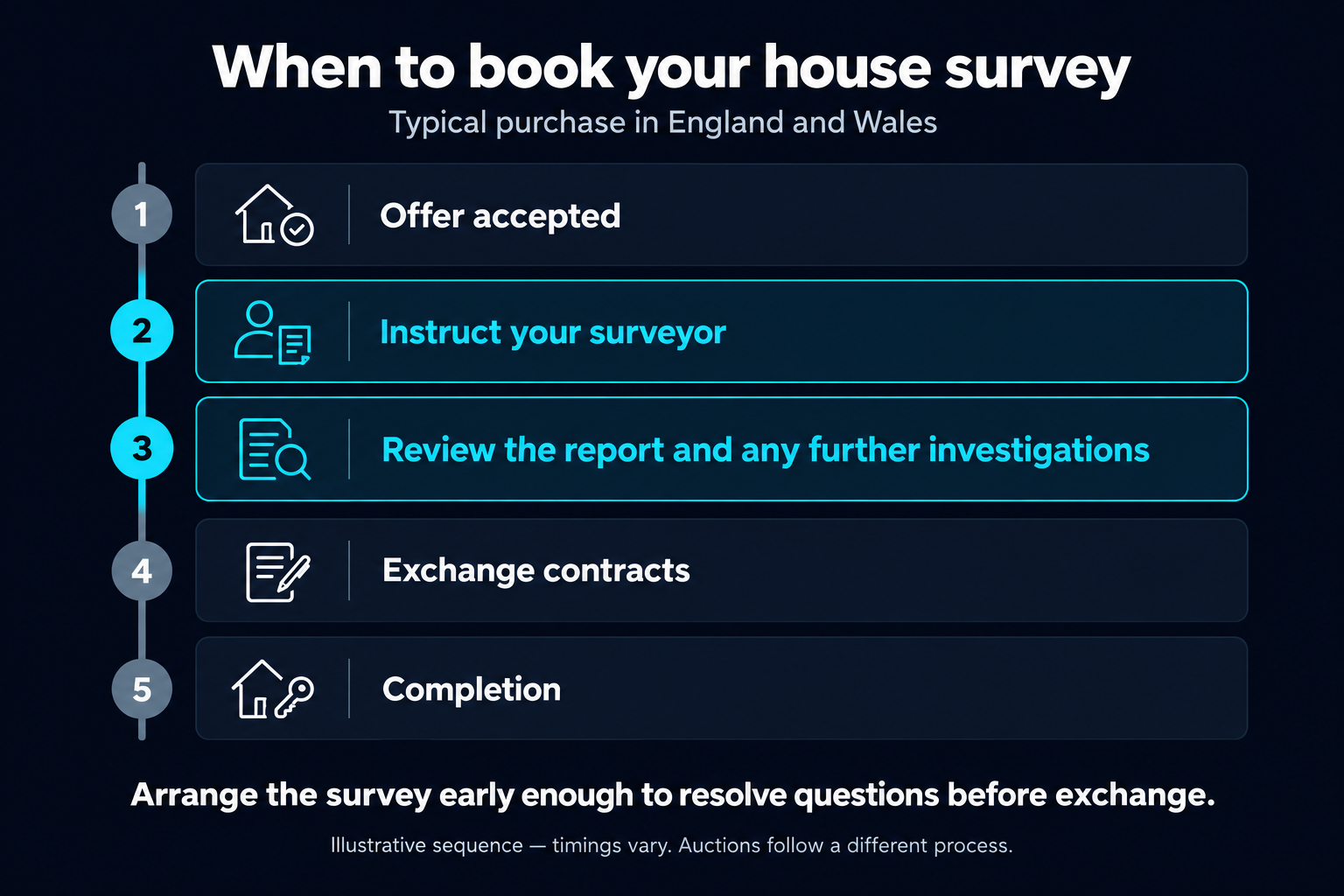
Book your survey after your offer has been accepted and well before you exchange contracts. As a practical starting point, contact surveyors during the first week or two after acceptance, then agree a timetable that leaves room to review the report and investigate any concerns.
Exchange is the deadline that matters. The inspection, report and any necessary follow-up should fit before it.
This guide focuses on standard residential purchases in England and Wales. Auctions and new builds can follow different arrangements, explained below.
The window
| Stage | Can you survey? | Notes |
|---|---|---|
| Before making an offer | Yes, if the seller agrees to access | It is possible, but you risk paying for an inspection before a price or purchase is agreed. |
| Offer accepted, sold subject to contract | Yes — usually the practical booking window | Before exchange, findings can inform whether you proceed and any negotiations. |
| After exchange of contracts | Yes, but too late to inform your decision before legal commitment | Withdrawing can have serious financial consequences. Speak to your conveyancer about your position. |
| After completion | Yes, but it cannot inform a purchase already completed | An inspection can still help you understand defects and plan repairs. |
Work backwards from exchange, not forwards from your offer
Most advice tells you to book as soon as your offer is accepted. That is a useful starting point, but it does not explain why leaving enough time matters.
Here is what may need to fit between the inspection and exchange:
- The surveyor inspects the property.
- The report is written and sent to you.
- You read it and speak to the surveyor about anything unclear.
- If further investigation is recommended, a specialist attends and reports.
- Where needed, you obtain written quotations for repairs.
- If you want to renegotiate, you discuss the findings through the estate agent and keep your conveyancer informed.
Steps four to six can take additional time. A structural engineer or drainage specialist has their own availability, and contractor quotations may take time to obtain. Our guide on what to do when a survey finds something explains how to work through the findings.
If you book late and the report raises something serious, you may need to delay exchange to investigate it properly. Booking early gives you more room to make an informed decision.
An anticipated exchange date is a planning target, not a reason to ignore unresolved findings. Tell your conveyancer if you are still waiting for the report or necessary investigations.
Should you wait for the mortgage valuation?
There is a genuine timing trade-off.
The argument for waiting is that your lender arranges its own valuation. If the valuation is below your agreed price or the lender will not lend on the property, the purchase may need renegotiating or may not proceed. A survey already carried out will generally still need to be paid for.
The argument for not waiting is that the mortgage process can take time, and you may need that time for investigations before exchange.
The government's guide to buying a home acknowledges both approaches. Some buyers arrange their survey as soon as their offer is accepted, while others wait until the lender has carried out its valuation and confirmed the amount it is willing to lend. It also warns that surveyors may be busy, so buyers should not leave it too late.
A reasonable way to decide:
- Comfortable with the purchase progressing and the risk of paying for a survey if it falls through? Booking early gives you more time to deal with findings.
- Concerned about a down valuation or whether the property is mortgageable? Discuss the mortgage position with your broker or lender before deciding when to incur the survey cost.
- Waiting for the valuation? Ask surveyors about availability now. Check whether a provisional booking is possible and what cancellation or rearrangement terms apply.
- Buying an unusual, altered or poor-condition property? Seek surveying advice early because further investigations may take time, while also considering any uncertainty about finance.
Remember that the two are different pieces of work. The lender's mortgage valuation helps the lender assess whether the property is adequate security for the loan. It does not replace a buyer's condition survey, and a satisfactory valuation is not the same as a final mortgage offer.
The risk of booking before the sale is certain
For a standard purchase in England and Wales, an accepted offer is generally not legally binding until exchange. Either side may withdraw before that point.
If you commission a survey and the sale later falls through, you may have spent money on a property you will not buy. If the inspection has already taken place, the fee will generally remain payable. If it has not, any cancellation charge or refund depends on the agreed terms and work already undertaken.
That is a real cost and it is worth being clear about.
Paying for a survey on a purchase that falls through is frustrating, but committing to a property without understanding significant defects can expose you to much greater costs.
If a chain looks fragile, it can be reasonable to wait briefly for the position to become clearer. Keep the survey timetable under review rather than allowing a short delay to leave too little time before exchange.
Decide the level before you book
The level can affect both the inspection time and report turnaround. A Level 3 survey on a large period property will generally involve more work than a Level 2 survey on a straightforward modern home. Ask the firm about availability and delivery times for your particular property.
For most conventional homes in reasonable condition, a RICS Level 2 Home Survey is a common choice. Older, larger, altered, unusual or run-down properties may point toward Level 3. Our guide on deciding between Level 2 and Level 3 works through the differences.
If you have not yet settled whether to commission one at all, start with whether a survey is worth it.
Describe the property and any planned alterations to the surveying firm before booking so it can recommend an appropriate service.
What to ask when you instruct
- What is your current availability? Ask about a realistic inspection date rather than assuming a slot will be available.
- How soon after inspection will I receive the report? Confirm the expected turnaround for the service you are booking.
- Is a conversation about the report included? Find out how you can ask follow-up questions.
- Do you have experience of this property type and age? This is particularly relevant for older London buildings.
- Who will inspect the property and prepare the report? For an RICS Home Survey, ask about the surveyor's RICS membership, relevant experience and the service being provided.
- What are the cancellation and rearrangement terms? Check before paying or reserving an appointment.
- What access is required? Mention tenants, communal areas or any known restrictions.
Tell the surveyor about specific concerns and planned works before the inspection. This helps them advise on the appropriate scope and whether additional services may be needed.

Access can add time
Access is normally coordinated with the estate agent or seller, often by the surveying firm. Confirm who will arrange it.
Tenanted properties may require notice and agreed access arrangements. Vacant properties may need keys collected, and access to communal areas in flats may require coordination with a managing agent.
Flag anything unusual when you book. Ask how restricted access would affect the inspection and report.
Two cases where the timing changes
Buying at auction
For a traditional or unconditional auction, the successful bid normally creates a binding purchase contract. Arrange any survey and necessary legal checks before bidding so you understand the property and the obligations you are taking on.
Conditional or modern-method auctions work differently, but a successful bid can still involve fees and significant commitments. Ask your conveyancer to explain the auction terms before you bid.
A pre-auction survey is not a universal legal requirement, but leaving investigations until after you have committed can expose you to substantial risk. Budget for the possibility of paying for advice or inspections on a property you do not ultimately buy.

Buying a new build
An independent snagging or pre-completion inspection may be more useful than a conventional condition survey, depending on the property and your concerns.
New-build buyers may exchange contracts before construction is finished, so an inspection before exchange will not always be possible. Ask early about inspecting the completed home before legal completion.
Where the New Homes Quality Code applies, the developer must provide an opportunity for a pre-completion inspection by the buyer or a suitably qualified inspector. Check which code and contractual arrangements apply to your purchase.
If inspection before completion is not available, discuss the position with your conveyancer and arrange an inspection as soon as practicable afterwards. Report defects promptly through the developer's process and check the relevant warranty terms.
Frequently asked questions
When should I book a house survey?
Contact surveyors after your offer is accepted and leave enough time before exchange for the inspection, report and any further investigations. Making enquiries during the first week or two is a useful starting point, rather than a fixed rule or guaranteed booking window.
Can I get a survey before making an offer?
Yes, if the seller agrees to access and a surveyor is available. However, you risk paying for an inspection before agreeing a purchase. Surveys and legal checks before bidding are particularly important for auction properties.
Should the survey come before or after the mortgage valuation?
Either approach can work. Booking early gives you more time for follow-up investigations. Waiting may reduce the risk of paying for a survey if the lender's valuation or lending decision stops the purchase. Consider your circumstances and ask about surveyor availability before deciding.
Who books the survey, me or my solicitor?
The buyer normally chooses, instructs and pays the surveying firm. Your conveyancer handles the legal work and searches and may help with a referral, but do not assume a survey has been arranged unless this is confirmed.
What if the sale falls through after I have paid?
If the inspection has already taken place, the fee will generally remain payable. If it has not, check the firm's cancellation terms and what work has already been done. Do not assume the payment will either be fully refundable or automatically lost.
How long will it take to get booked in?
It depends on the firm, property, location, access arrangements and time of year. Ask separately about the inspection date and the expected report delivery date.
Is it too late if I am close to exchange?
Not necessarily. Tell your conveyancer immediately that the survey or further investigations are outstanding. You may need to move the proposed exchange date. Once you exchange, your options to withdraw or renegotiate are significantly more limited.