The First-Time Buyer's Guide to House Surveys
Buying your first home means meeting a lot of unfamiliar words at once. This guide runs through the survey part in the order you will actually need it: whether to get one, what it costs, which to choose, when to book, how to read it, and what to do if it finds something.
Each stage links to a fuller guide if you want the detail.
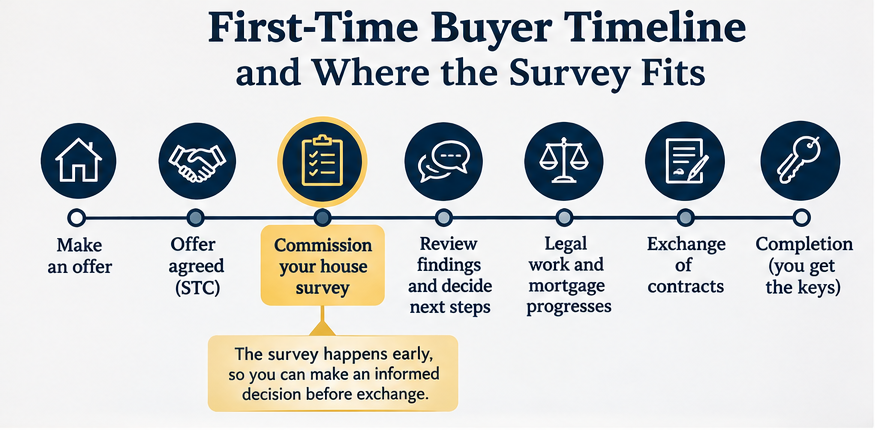
Before anything else: three things worth knowing
Your mortgage valuation is not a survey. It is a limited check carried out so your lender can confirm the property is adequate security for the loan. The government's guide to buying a home says it plainly: a valuation does not protect you if something goes wrong with the property, and it may not even involve a physical inspection. If the valuation was free with your mortgage, that is not a survey you have already had. Here is how the lender's mortgage valuation differs.
You cannot rely on someone else's survey. If the seller, or a previous buyer whose purchase fell through, offers you their report, you can read it for information but it was not prepared for you and carries no duty of care to you. Ask your conveyancer before placing any weight on it.
Ignore the age rules you will read online. You will be told Level 2 suits homes built after 1900, or in the last 50 years, or the last 150 years, and that Level 3 is for anything older than 1970, or pre-1930. Those are four different rules and none of them comes from RICS. More on this below.
Stage 1: Decide whether to have one
A survey is not generally a legal requirement when buying a home in England and Wales, but the government's buying guidance says buyers should strongly consider having one carried out. Scotland and Northern Ireland have different home-buying systems and buyers there should take advice appropriate to their jurisdiction.
The case is straightforward: a buyer-commissioned survey provides an independent inspection focused on the condition of the property before the buyer becomes legally committed.
There are a few situations where it may not be the right spend, and our guide on whether a survey is worth the cost goes through them honestly rather than concluding yes automatically.
Stage 2: Work out the budget
Survey fees vary by level and property, broadly from a few hundred pounds for the most basic report to over a thousand for the most detailed on a larger or older home. Our guide to what a house survey costs breaks it down by level, and there is a separate guide to survey costs in London where fees run higher.
Budget it alongside the rest. The government's guide lists surveys together with stamp duty, conveyancing fees, search fees, buildings insurance and moving costs. First-time buyers routinely plan for the deposit and underestimate everything after it.
One thing to be clear about: a survey is not insurance. It does not pay out if something goes wrong. What it buys is information before you commit.
Stage 3: Choose the level
RICS, the Royal Institution of Chartered Surveyors, defines three Home Survey service levels and sets minimum expectations for each. The framework promotes consistency, although individual firms may differ in presentation, terms of engagement and any additional services they offer.
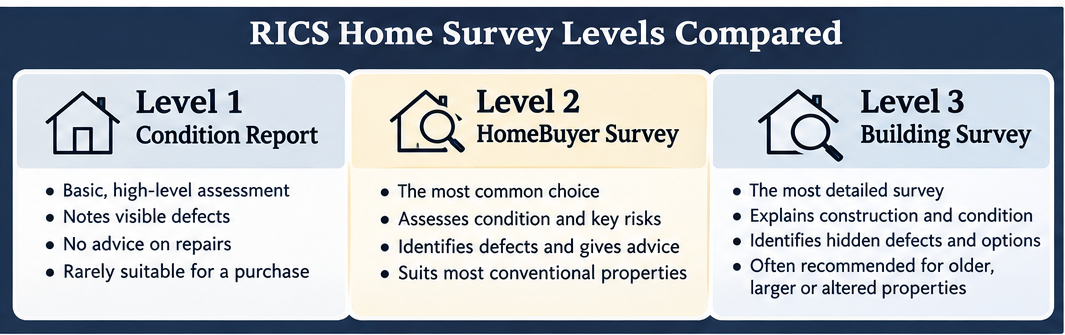
| Level | In short | Typically suits |
|---|---|---|
| Level 1 Condition Report | Describes condition, flags urgent defects, no repair advice | Conventional, newer homes in good condition |
| Level 2 HomeBuyer | Adds advice on repairs and maintenance, and more extensive roof space and drainage inspection | Conventional property in reasonable condition, simple in form and layout |
| Level 3 Building Survey | Adds analysis of causes, repair options, timescales and hidden defect risk | Large, older, run-down, unusual or altered property, or where major works are planned |
Most buyers land on Level 2. Our guides compare Level 1 against Level 2 and Level 2 against Level 3 if you are weighing two of them, or you can go straight to a RICS Level 2 HomeBuyer survey or a Level 3 Building Survey.
The age rule that is not a rule
This is worth dwelling on, because you will meet it constantly.
RICS says the appropriate level depends in most cases on the age, size, condition, complexity and originality of the property. Age is one factor of five. There is no year threshold anywhere in the guidance.
The thresholds you will read online are rules of thumb that different firms have invented, which is why they contradict each other. A tidy modern flat and a heavily extended house of the same date are not the same job, and a well-maintained unaltered period house and a neglected one are not either.
If you are unsure, describe the property to a surveyor before booking and ask which service level they recommend. RICS advises buyers to discuss their requirements with the surveyor before the inspection. Check with the individual firm whether any initial advice or consultation carries a fee.
Stage 4: Think about what you are buying
Some property types shift the decision.

Period houses
Victorian and Edwardian homes are built differently from modern housing and usually carry a long history of alterations. Our guide to Victorian and period houses covers what changes.
Flats
A survey on a flat covers the flat and the parts of the building within the scope of the inspection that the surveyor can see and safely access. It is not a structural survey of the whole block, it does not normally provide a specialist external-wall-system assessment, and it does not interpret your lease.
If you are buying a leasehold flat, those distinctions matter. Your conveyancer should advise on the lease, service charges, legal responsibilities and other legal documentation.
New builds
A condition survey may add less on a newly completed home where the main concerns relate to workmanship and unfinished items. A snagging inspection is often the more targeted option for a brand-new property bought directly from a developer.
The appropriate inspection still depends on the individual property and transaction.
Stage 5: Book it
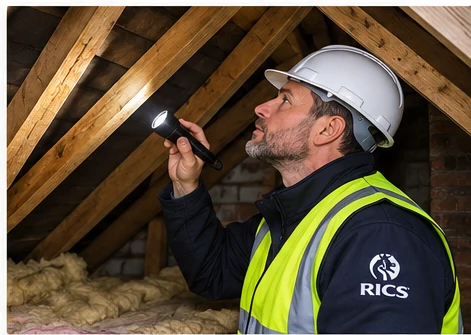
Book after your offer is accepted and allow enough time before exchange for the inspection, report and any follow-up enquiries.
In many transactions, instructing within the first week or two can provide more time to investigate anything the report raises, although timing will depend on the transaction and surveyor availability.
The reason is not just the survey itself. If something is found, a specialist may need to investigate, quotes may need to be obtained, and any renegotiation can take additional time. Exchange is therefore an important milestone to work back from.
Our guide on when to book covers the timing, including whether to wait for the mortgage valuation first.
Inspection time varies considerably depending on the property, survey level, condition, size, complexity and accessibility. The appointed surveyor should confirm the expected scope and reporting timeframe for the individual instruction.
You book and pay for the survey yourself. Your conveyancer handles the legal work, and the two processes normally run in parallel.
Stage 6: Read the report properly
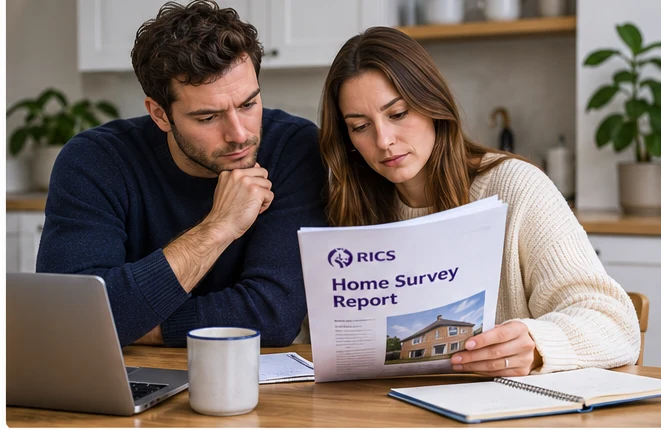
Expect it to look alarming. Reports are written to flag problems, and on any older property the list will often be long. That is the document doing its job, not automatically a verdict on the purchase.
Understand what it covers. A survey is generally a visual inspection with real limitations. The precise scope depends on the service level and the appointed surveyor's terms of engagement.
A Home Survey does not mean every service has been tested, every concealed area opened up or every possible defect identified.
Our guide to what the survey covers sets out what falls inside and outside the inspection.
Understand the ratings. Findings are scored, and our guide to what the condition ratings mean explains the system, including the category recording areas or elements the surveyor could not inspect.
Read the whole thing, not only the summary. A summary or headline rating can sometimes make a localised defect appear more significant without the context contained in the main report.
Then speak to the surveyor. If post-report discussion is included within the agreed service, it can be one of the most useful ways to understand which findings actually matter.
Stage 7: Act on what it says
If the report raises no significant concerns, that can provide useful reassurance about the property's condition within the scope and limitations of the inspection.
It does not guarantee that the property is free from hidden or future defects.
If it finds something, the options available before exchange may include proceeding as agreed, asking whether the seller will carry out work, renegotiating the price or withdrawing.
The appropriate response depends on the seriousness and certainty of the findings, your transaction and the advice of your surveyor and conveyancer.
Our guide on what to do if the survey finds something works through how to judge which response may be appropriate, including the difference between a defect the surveyor has diagnosed and one where further investigation is recommended.
If you decide to go back on price, do it on evidenced repair costs rather than simply applying an arbitrary percentage of the purchase price. Our guide on how to renegotiate sets out how to build the case.
What first-time buyers most often get wrong
- Assuming the free mortgage valuation covers them. It does not.
- Leaving the booking too late, so there is no time to investigate anything the report raises before exchange.
- Choosing the level on price alone rather than on the property.
- Reading only the summary and the coloured boxes.
- Treating a report with no significant concerns as money wasted.
- Relying on someone else's survey even though it was not prepared for them and may not provide them with the same contractual rights or duty of care.
Frequently asked questions
Do first-time buyers need a survey?
It is not generally a legal requirement when buying in England and Wales, but buyers are strongly encouraged to consider one. There is no separate survey rule for first-time buyers; the practical difference is that a first-time buyer may have less experience identifying potential property issues at a viewing.
What survey should a first-time buyer get?
Most buyers of conventional property in reasonable condition may find a Level 2 appropriate. Older, larger, altered, unusual or more complex property may point toward Level 3. The correct level should be chosen based on the individual property rather than age alone.
Is the mortgage valuation enough?
No. A lender's mortgage valuation is carried out for lending purposes and is not the same as a buyer-commissioned Home Survey. It should not be relied on as a detailed assessment of the property's condition.
Can I use the seller's survey?
You can read a report supplied by someone else for information, but it was not prepared under your own instruction and you should not assume you have the same contractual rights or duty of care as the original client. Ask your conveyancer and the relevant surveyor before relying on it.
When should I book?
After your offer is accepted and with enough time before exchange to deal with anything the report raises. In many transactions, arranging the survey during the early stages of the purchase gives more time for follow-up investigation if needed.
What if the survey finds problems?
Most reports identify some issues. Depending on their seriousness and certainty, you may decide to proceed, obtain further investigation, ask whether the seller will carry out work, renegotiate or withdraw before exchange. Take advice relevant to your own transaction.
Does the survey tell me what repairs will cost?
Not usually as part of the standard RICS Home Survey service. The report may describe defects, their significance and, depending on the service level, repair options or recommended further investigations. Detailed repair pricing normally requires quotations from appropriate contractors or specialists.
Get a survey quote
Tell us about the property, including its type, approximate age and any concerns you already have, and we will help you understand which type of survey may be appropriate and connect you with an independent surveyor where relevant.
Important: This guide is provided for general information only and is not legal, financial, mortgage, valuation, structural engineering or surveying advice. Property transactions and individual buildings differ. You should take advice from your own conveyancer, lender or mortgage adviser and the surveyor appointed for your property before making decisions or entering into a legal commitment. A home survey is subject to the scope, limitations and terms of engagement agreed with the appointed surveyor and cannot guarantee that all defects will be identified.
Reading this guide or contacting Property Survey Experts does not by itself create a surveyor-client, solicitor-client, financial-adviser or other professional advisory relationship.